What It's Really Like to Work as a Long-Haul Truck Driver
Weeks on the road, federal hours-of-service limits, and pay by the mile — here is how the work actually feels before you pay for a CDL course.
Long-haul truck driving pays you to move freight between distant cities, which means living in a sleeper berth, working to federal driving-hour limits, and handling the loading, paperwork and inspection work on every trip. Most drivers attend a professional truck driving school and must hold a commercial driver's license, and most are paid by the mile driven rather than by the hour (U.S. Bureau of Labor Statistics, 2025).
It suits people who are comfortable alone and methodical about safety checks, and who will trade a predictable home routine for long stretches away.
What This Career Involves Day to Day
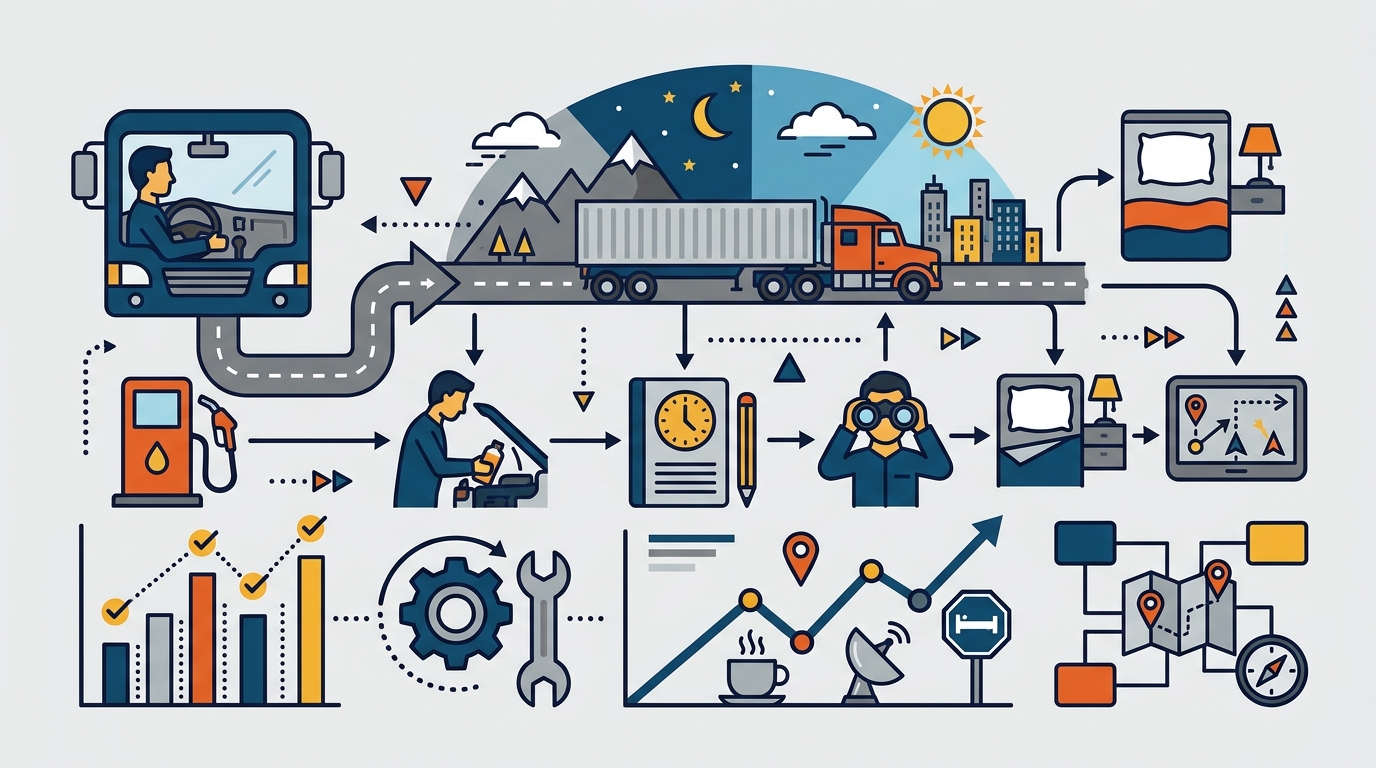
A day starts in the sleeper berth, not at a desk. Before the wheels turn you walk the pre-trip inspection: tire tread and pressure, air lines and glad hands between tractor and trailer, lights, the fifth-wheel coupling and a brake check. Inspecting the trailer before and after each trip is a standard duty, as is reporting mechanical problems to the carrier's maintenance shop (U.S. Bureau of Labor Statistics, 2025).
Then you log on duty. Driving time and duty status go into an electronic logging device or logbook, and you read the bill of lading and check the load documentation against what is actually on the trailer (O*NET OnLine, U.S. Department of Labor, 2026).
At a shipper you may crank the trailer landing gear by hand, back a 53-foot trailer into a dock on mirrors alone, and secure cargo with ropes, blocks, chains or covers (U.S. Bureau of Labor Statistics, 2025). Between stops you fuel, add oil or radiator fluid, check safety and emergency equipment, make minor repairs and wash the truck (O*NET OnLine, U.S. Department of Labor, 2026).
The driving is long and mostly solitary, broken by scale houses, construction zones, weather and dock appointments that run late. At delivery you obtain a signed receipt, update your log and start hunting for legal parking before the duty clock runs out — federal hours-of-service rules cap driving and on-duty time and require off-duty rest (U.S. Bureau of Labor Statistics, citing Federal Motor Carrier Safety Administration rules, 2025).
Signs This Career Might Suit You
- You have driven several hours alone with no music or company and found it calming rather than boring.
- You check your own tire pressure and fluids instead of waiting for a warning light.
- You keep receipts, mileage and times carefully, because you were once burned by not having them.
- You can sleep in a parked vehicle and wake up functional.
- You stay calm when a dock appointment is pushed back four hours with no explanation.
- You are willing to strap and tarp a load in the rain rather than wait for better weather.
Signs This Career Might Not Be for You
- Long-haul schedules keep drivers away from home for extended stretches (U.S. Bureau of Labor Statistics, 2025), so you will miss weekday evenings, school events and weekends that other jobs protect.
- Truck drivers have one of the highest rates of occupational injuries, illnesses and fatalities of all occupations (U.S. Bureau of Labor Statistics, 2025); crashes, falls from the trailer and strains from cargo handling are real exposures.
- Because pay is usually by the mile driven (U.S. Bureau of Labor Statistics, 2025), hours spent waiting at a dock or sitting out a breakdown can earn far less than hours rolling, so income is uneven week to week.
- Federal rules require a periodic physical exam and random drug and alcohol testing for CDL holders (U.S. Bureau of Labor Statistics, 2025); a disqualifying result stops your ability to work immediately.
Skills and Traits That Matter Most
| Skill/Trait | Why It Matters on the Job |
|---|---|
| Methodical inspection habits | The pre-trip walkaround — tires, air lines, lights, fifth wheel — catches a defect before it becomes a roadside breakdown or a violation. |
| Spatial judgment | Backing a 53-foot trailer into a dock on mirrors, and cranking the landing gear to the right height, decides whether you couple cleanly or damage equipment. |
| Record-keeping discipline | Hours go into a logbook or electronic logging device, and receipts and bills of lading must match the freight; sloppy paperwork creates pay disputes. |
| Patience under delay | Dock appointments slip and scale lines back up; agitated drivers start pushing the hours-of-service clock, which is where mistakes happen. |
| Comfort with solitude | Most of the shift is you, the cab and dispatch messages, with human contact limited to a signature at the dock. |
| Basic mechanical confidence | Adding oil or radiator fluid, making minor repairs and describing a fault accurately to the maintenance shop keeps a load moving. |
Pay, Hours, and Outlook
| Item | What to Know |
|---|---|
| Median annual wage | Published for heavy and tractor-trailer truck drivers by the U.S. Bureau of Labor Statistics (2025); look up the current figure before paying for training. |
| How pay is structured | Usually by the mile driven, plus bonuses, with the per-mile rate varying by employer; some long-distance and owner-operator drivers are paid a share of shipping revenue (U.S. Bureau of Labor Statistics, 2025). |
| Typical hours | Long-haul drivers often work extended hours and spend long periods away from home (U.S. Bureau of Labor Statistics, 2025). |
| Legal limits on hours | Federal hours-of-service rules set maximum driving and on-duty time and required rest (U.S. Bureau of Labor Statistics, citing Federal Motor Carrier Safety Administration rules, 2025). |
| Projected employment growth | A growth rate for 2025–35, plus projected average annual openings over the decade, is published by the U.S. Bureau of Labor Statistics (2025). |
| Size of the occupation | The U.S. Bureau of Labor Statistics (2025) publishes the total number of jobs held in this occupation. |
The wage, growth and openings figures come from the U.S. Bureau of Labor Statistics Occupational Outlook Handbook (2025), which is updated periodically; check it directly for current numbers. Earnings also depend on the carrier, the freight type and dispatched miles, and per-mile rates differ by employer and by state freight market. Hours-of-service limits are federal, but some states apply different rules to purely intrastate driving.
How People Usually Get Started
- Confirm you can meet the federal medical standards. CDL holders must pass a periodic physical exam, meet federal vision and hearing standards, and submit to random drug and alcohol testing (U.S. Bureau of Labor Statistics, 2025). Check this before spending money on training.
- Pass the CDL knowledge test to obtain a commercial learner's permit. CDL qualification generally requires both a knowledge test and a driving skills test (U.S. Bureau of Labor Statistics, 2025), administered through your state licensing agency.
- Attend a professional truck driving school. Most drivers attend one before being hired (U.S. Bureau of Labor Statistics, 2025); program lengths are set by the school and are typically measured in weeks rather than years, so ask for the published length and total cost in writing.
- Pass the CDL driving skills test and get licensed — the behind-the-wheel portion, including the vehicle inspection and backing maneuvers practiced at school.
- Hire on with a carrier that runs a mentor program. New drivers normally receive on-the-job training riding with an experienced mentor-driver (U.S. Bureau of Labor Statistics, 2025). Long-haul carriers, private fleets, and tanker or flatbed specialists all hire new CDL holders on different terms.
- Add endorsements once working. A hazardous materials (HAZMAT) endorsement requires an additional knowledge test and a background check (U.S. Bureau of Labor Statistics, 2025).
Frequently asked questions
Do I need a college degree to drive long-haul?
No. The U.S. Bureau of Labor Statistics (2025) lists a high school diploma or equivalent as the typical entry-level education for heavy and tractor-trailer truck drivers, and O*NET (2026) places the occupation in a Job Zone reflecting moderate preparation rather than a degree. What you do need is a commercial driver's license, and most drivers attend a professional truck driving school first.
Is the work physically demanding, or is it just sitting?
Both. You sit for long driving stretches, then handle physical tasks like cranking trailer landing gear, climbing in and out of the cab, and securing cargo with ropes, blocks, chains or covers (U.S. Bureau of Labor Statistics, 2025). Truck drivers also have one of the highest rates of occupational injuries, illnesses and fatalities of all occupations (U.S. Bureau of Labor Statistics, 2025).
Will I be paid for time spent waiting at a dock?
Not usually at the same rate as driving. Drivers are generally paid by the mile driven, plus bonuses, with the rate varying by employer; some long-distance and owner-operator drivers are paid a share of shipping revenue instead (U.S. Bureau of Labor Statistics, 2025). Detention and layover pay, where it exists, is a policy each carrier sets, so ask how it is calculated.
Can I drive if I wear glasses or a hearing aid?
Federal regulation sets specific vision and hearing standards that truck drivers must meet, and CDL holders must pass a periodic physical exam (U.S. Bureau of Labor Statistics, 2025). How corrective lenses or hearing devices are assessed is decided at that medical exam, not by an employer. Book the exam early so you know where you stand before paying tuition.
How is this different from local delivery driving?
Light truck and delivery service drivers generally return home at the end of each shift and make many short stops. Long-haul drivers cover long distances between cities, sleep in the truck, and work under federal hours-of-service driving and duty limits (U.S. Bureau of Labor Statistics, citing Federal Motor Carrier Safety Administration rules, 2025). The trade is fewer daily stops in exchange for far more time away.
Sources
- U.S. Bureau of Labor Statistics — Heavy and Tractor-Trailer Truck Drivers : Occupational Outlook Handbook (2025)
- O*NET OnLine (U.S. Department of Labor) — 53-3032.00 - Heavy and Tractor-Trailer Truck Drivers (2026)

Written by
Yuki covers the broader shifts in how people work: shrinking industries, growing ones, the policies that quietly decide who gets steady income. She tends to start stories with a worker's own account before zooming out.