How to Become a Dental Hygienist: Step-by-Step Guide
Dental hygiene is licensed clinical work you can enter with a two- to three-year degree, if you are comfortable with close, hands-in-mouth patient contact.
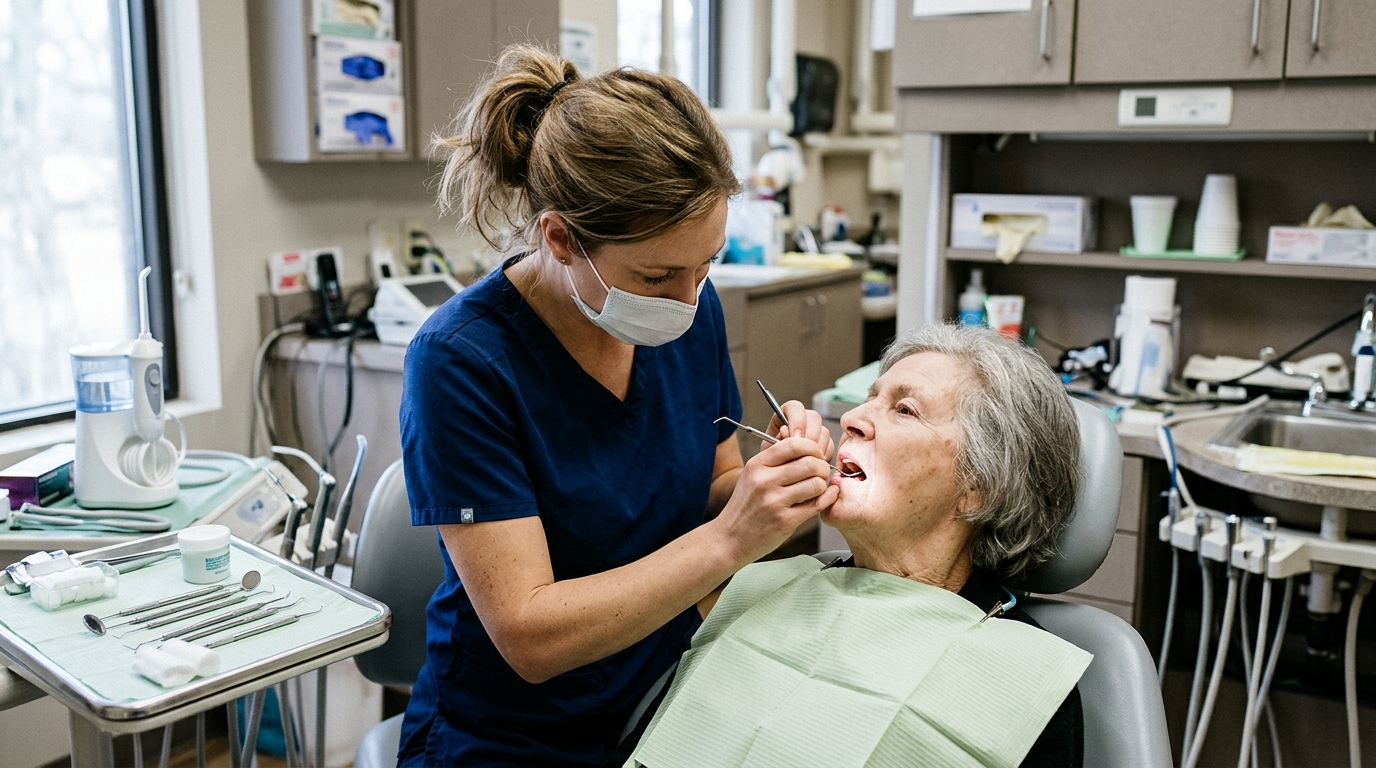
Becoming a dental hygienist means finishing a program accredited by the Commission on Dental Accreditation (CODA), passing the National Board Dental Hygiene Examination (NBDHE) from the Joint Commission on National Dental Examinations, passing a clinical board exam, and then applying to a state licensing board. Dental hygienists typically need an associate's degree, and programs usually take three years to complete (U.S. Bureau of Labor Statistics, 2025). All states require a license and the requirements differ by state (U.S. Bureau of Labor Statistics, 2025).
The work itself is repetitive, close-quarters clinical care: scaling deposits off teeth, probing gums, taking radiographs and talking anxious patients through it, appointment after appointment.
Step-by-Step Path to This Career
- Finish a high school diploma or GED (already done for most readers). The path runs from a diploma or GED into an accredited dental hygiene degree (American Dental Hygienists' Association, 2025). Biology, chemistry and anatomy grades matter, because most programs screen on them.
- Complete prerequisite college coursework (1 to 2 semesters). Programs commonly ask for anatomy and physiology, microbiology, chemistry and English before you may apply. Confirm the exact list with each school, since it is set program by program.
- Apply to a CODA-accredited program (3 to 9 months of applications). CODA is a specialized accrediting body recognized by the United States Department of Education (Concorde Career Institute, undated), and there are more than 300 accredited dental hygiene programs in community colleges, technical colleges, dental schools and universities (Harper College citing the BLS Occupational Outlook Handbook, 2022). Only students and graduates of CODA- or CDAC-accredited schools may sit the ADEX Dental Hygiene Examination (American Board of Dental Examiners, undated).
- Earn the degree (2 to 3 years full time). Hygienists typically need an associate's degree and programs usually take three years (U.S. Bureau of Labor Statistics, 2025); most associate programs take at least two (Harper College, 2022). You treat patients in a supervised student clinic for much of the second half.
- Pass the NBDHE (sit it in your final year; allow 2 to 3 months of study). It is a written, pass/fail exam with discipline-based and case-based portions, administered by the Joint Commission on National Dental Examinations (Goodwin University citing JCNDE, undated). Eligibility requires certification by a CODA-accredited program director, or graduation from a CODA-accredited or equivalent program (JCNDE, 2025).
- Pass a clinical board examination (one exam day, booked 2 to 4 months ahead). The ADEX Dental Hygiene Examination has two parts — a clinical exam and a simulated computer-based CSCE/OSCE component — and is built for portable licensure (American Board of Dental Examiners, undated). Regional and state clinical exams are administered by CDCA-WREB-CITA, which administers the ADEX exam, plus CRDTS and SRTA (American Dental Hygienists' Association, August 2024).
- Apply to your state board for the RDH licence, then start a first post (4 to 12 weeks, then ongoing). All states require licensure and requirements vary by state (U.S. Bureau of Labor Statistics, 2025); Florida law, for example, sets a nonrefundable application fee and a separate examination fee, each capped at a maximum set by the board (The Florida Senate, 2020). Most new graduates start as a staff hygienist in general dentistry, with renewal, CPR and continuing education rules set by the state board.
Education and Training Options Compared
There is no bootcamp or short-course route here. Every path runs through a CODA-accredited program, because that accreditation drives NBDHE eligibility (JCNDE, 2025) and ADEX clinical exam eligibility (American Board of Dental Examiners, undated).
| Path | Time | Typical Cost | Outcome |
|---|---|---|---|
| Community or technical college associate degree | At least 2 years, commonly 3 (U.S. Bureau of Labor Statistics, 2025; Harper College, 2022) | Per-credit tuition on the college's published schedule at the in-district rate, plus a required instrument kit, loupes and uniform billed in the first clinical term | Associate degree, NBDHE and clinical board eligibility, RDH licensure |
| University or dental-school bachelor's degree | 4 years including prerequisites (American Dental Hygienists' Association, 2025) | University tuition at the published resident or non-resident rate, plus the same clinic kit and board exam fees | Bachelor's degree, same RDH path, and the credential usually asked for in public health, teaching and corporate clinical roles |
| Degree-completion program for a licensed RDH | 1 to 2 years, often part time and online | Per-credit tuition for upper-division courses only; no second instrument kit, no clinical board fee | Bachelor's degree while working clinically; no new license needed |
Ask each program for its current tuition schedule, its CODA accreditation status and its board pass rates before you pay a deposit.
What You'll Actually Be Doing Once You Start
Your first 6 to 12 months are the same sequence of tasks repeated on 8 to 12 patients a day. Core duties include recording and reviewing patient medical histories, examining gums with a probe for periodontal disease, cleaning calcareous deposits with dental instruments, exposing and developing x-ray film, and applying fluoride and other cavity-preventing agents (O*NET OnLine, 2026).
In practice that means calling out pocket depths with a periodontal probe, running an ultrasonic scaler and finishing with hand curettes, placing sensors or film for bitewing radiographs, charting in the practice's dental software before the dentist's exam, and sterilizing and setting up instrument cassettes. Physically, you sit leaning in a fixed posture for 30 to 60 minutes per appointment, make repetitive wrist and hand movements with hand instruments all day, and work in aerosol and saliva exposure that requires gloves, mask and eye protection on every patient. You will also meet patients who have avoided dental care for years and who get defensive or tearful when bleeding gums are probed.
What separates you from senior staff: the dentist diagnoses disease and does restorative work. An experienced hygienist takes complicated periodontal maintenance cases, needs less chair time, trains new graduates on charting conventions, and may move into public health or teaching in a dental hygiene program — which usually assumes a bachelor's degree.
Costs and Time Investment
No single body publishes one total for this path, because tuition is set by each school and licensure fees by each state board. Budget for these items and look up each current amount yourself.
| Cost item | Step | How the amount is set |
|---|---|---|
| Prerequisite college courses | Step 2 | Per-credit rate published by the college teaching anatomy, microbiology and chemistry |
| Program tuition and fees | Step 4 | The CODA-accredited program's published schedule; resident and non-resident rates differ at public colleges |
| Instrument kit, loupes, scrubs, immunizations | Step 4 | Itemized on the program's required-equipment list, billed in the first clinical term |
| NBDHE examination fee | Step 5 | Published by the Joint Commission on National Dental Examinations, which administers the exam (Goodwin University citing JCNDE, undated) |
| ADEX Dental Hygiene Examination | Step 6 | A stated examination fee plus a facility fee that varies by clinical location and a typodont fee; includes one complimentary retake of the initial clinical exam (American Board of Dental Examiners, undated) |
| Regional clinical exam | Step 6 | Fee schedules published by CDCA-WREB-CITA, CRDTS or SRTA (American Dental Hygienists' Association, August 2024) |
| State licence application and exam fees | Step 7 | Set by the state board — Florida caps a nonrefundable application fee and a separate examination fee at maximums set by the board (The Florida Senate, 2020) |
| Renewal, CPR and continuing education | Step 7 | Set by your state board's renewal cycle |
For wage context, check the median annual wage reported for May 2024 (U.S. Bureau of Labor Statistics, 2025) and the hourly and annual percentiles on the CareerOneStop occupation profile (U.S. Department of Labor), which show the spread rather than one figure.
Common Entry Mistakes to Avoid
- Enrolling in a program that is not CODA-accredited (step 3). Only students and graduates of CODA- or CDAC-accredited schools may take the ADEX exam (American Board of Dental Examiners, undated), and NBDHE eligibility runs through a CODA program director or graduation (JCNDE, 2025). Fix: verify accreditation in writing before paying a deposit.
- Leaving prerequisites unfinished when you apply (step 2). Programs with limited clinical chairs rank applicants on completed science coursework, so anatomy still in progress can cost you a seat for a full admissions cycle. Fix: finish anatomy, physiology, microbiology and chemistry before the deadline.
- Treating the NBDHE as one format (step 5). It is a written, pass/fail exam with both discipline-based and case-based portions (Goodwin University citing JCNDE, undated), and candidates who only drill facts get caught by the case sets. Fix: spend at least a third of study time on full case-based practice.
- Booking the clinical board before site and typodont requirements are settled (step 6). The facility fee is tied to the clinical location and the typodont fee is separate (American Board of Dental Examiners, undated). Fix: confirm site, date and patient requirements with your program's board coordinator before you pay.
- Assuming one pass covers every state (step 7). All states require licensure and requirements vary by state (U.S. Bureau of Labor Statistics, 2025). Fix: read the destination board's licensure page before choosing which exam agency to test with. New York, for example, requires candidates who fail the clinical component twice to complete remedial instruction hours before retesting (New York State Education Department, undated).
Frequently asked questions
How long does it take from starting college to working as a hygienist?
Plan on two to three years of full-time study, since hygienists typically need an associate's degree and programs usually take three years (U.S. Bureau of Labor Statistics, 2025). Add one to two semesters if you still need prerequisite sciences, plus roughly one to three months after graduation for the NBDHE, the clinical board and licensure processing.
Will my licence work if I move to another state?
Not automatically. All states require licensure and requirements vary by state (U.S. Bureau of Labor Statistics, 2025), so you apply to each board separately. The ADEX Dental Hygiene Examination is built for portable licensure (American Board of Dental Examiners, undated) and is taken through CDCA-WREB-CITA, CRDTS or SRTA (American Dental Hygienists' Association, August 2024) — confirm acceptance with the destination board first.
What happens if I fail the clinical exam?
The ADEX fee includes one complimentary retake of the initial clinical exam (American Board of Dental Examiners, undated), so a first failure costs time rather than the full fee again. States add conditions: New York requires candidates who fail the clinical component twice to complete additional remedial instruction hours before retesting (New York State Education Department, undated).
Is there enough hiring to justify the training cost?
Employment is projected to grow much faster than the average for all occupations from 2024 to 2034, with about 15,300 openings a year (U.S. Bureau of Labor Statistics, 2025), and O*NET OnLine's Bright Outlook designation lists 75,000 or more openings nationwide over 2025 to 2035. For pay, check the May 2024 median annual wage from the Bureau of Labor Statistics and the wage percentiles on the CareerOneStop occupation profile for your state.
Sources
- U.S. Bureau of Labor Statistics — Dental Hygienists : Occupational Outlook Handbook (2025)
- CareerOneStop (U.S. Department of Labor) — Occupation Profile: Dental Hygienists

Written by
Desmond writes about the mechanics of job hunting — resumes, interviews, the strange rituals of being evaluated by strangers. He's drawn to the gap between how hiring is supposed to work and how it actually happens.