Physical Therapist Assistant Career Path: How to Get Started
Who the job suits, what the supervising therapist keeps control of, and which fees and test dates decide how fast you can start working.
Becoming a physical therapist assistant (PTA) means earning an associate's degree from a program accredited by the Commission on Accreditation in Physical Therapy Education (CAPTE), then being licensed or certified by your state. Programs typically run about two years and combine anatomy, physiology and kinesiology coursework with supervised clinical work (U.S. Bureau of Labor Statistics, 2025); some accredited programs can be finished in as few as 18 months (Rasmussen University, 2023-05).
Every state requires PTAs to be licensed or certified, which normally means graduating from an accredited program and passing a qualifying exam (U.S. Bureau of Labor Statistics, 2025). The work suits you if you like hands-on, repetitive coaching with the same patients over weeks, carrying out a plan someone else wrote.
Step-by-Step Path to This Career
- Finish high school or an equivalent and check the age floor. Some states set a minimum age of 18 for PTA licensure and require a criminal background check (U.S. Bureau of Labor Statistics, 2025). Take biology and anatomy if they are offered, because kinesiology coursework moves fast.
- Optional: work as a physical therapist aide first. Aides typically need a high school diploma or equivalent plus on-the-job training lasting about one week to one month, and states do not require aides to be licensed (U.S. Bureau of Labor Statistics, 2025). You see the clinic floor before committing tuition.
- Enroll in a CAPTE-accredited associate degree program (about 2 years; as few as 18 months in some accredited programs). All states require an associate's degree from an accredited program, with anatomy, physiology and kinesiology coursework plus supervised clinical work (U.S. Bureau of Labor Statistics, 2025; Rasmussen University, 2023-05). Nearly 350 PTA associate's degree programs were CAPTE-accredited in 2017 (U.S. Bureau of Labor Statistics, 2017).
- Earn Basic Life Support (BLS) certification — a two- or three-hour hands-on class, recertified every two years (Nurse.org, undated). Many programs want it on file before your first clinical rotation.
- Apply to your state licensing authority for NPTE-PTA eligibility. Eligibility requires being at least 18, meeting the education requirement through a CAPTE-accredited program, paying the exam fee and receiving approval from the licensing authority (Mometrix, undated). The Jurisdiction Approval Deadline falls about seven days after the registration and payment deadline (Federation of State Boards of Physical Therapy, undated). CareerOneStop lists state licensing boards and certification requirements (U.S. Bureau of Labor Statistics, 2025).
- Pass the National Physical Therapy Examination at the PTA level. Administered by the Federation of State Boards of Physical Therapy in January, April, July and October, with a lifetime limit of six attempts (Mometrix, undated). It runs 180 multiple-choice questions, 140 of them scored, over four hours, with a passing score of 600 on a 200–800 scale (FSBPT documents, undated); results usually arrive a few weeks later (Vivian Health, undated).
- Complete state-specific requirements and start in the setting your rotations covered. Some states also require an exam on state law, a criminal background check and a minimum age of 18 (U.S. Bureau of Labor Statistics, 2025). If your rotations were in a skilled nursing facility, you already know its documentation system and its gait-training equipment.
Education and Training Options Compared
| Path | Time | Typical Cost | Outcome |
|---|---|---|---|
| Community college CAPTE-accredited associate degree | About 2 years, including supervised clinical work (U.S. Bureau of Labor Statistics, 2025) | Published per-credit in-district tuition, plus the $485.00 NPTE-PTA fee and $92.00 Prometric sitting fee (FSBPT, undated) | Associate's degree that meets the education requirement in all states, plus NPTE-PTA eligibility |
| Accelerated, year-round accredited PTA program | As few as 18 months (Rasmussen University, 2023-05) | Published program tuition, plus the same $485.00 and $92.00 testing fees (FSBPT, undated) | The same accredited degree and NPTE-PTA eligibility, roughly six months sooner |
| Physical therapist aide on-the-job training | About 1 week to 1 month (U.S. Bureau of Labor Statistics, 2025) | High school diploma; a 2–3 hour BLS class if the employer requires it (Nurse.org, undated) | Unlicensed aide role doing setup, patient moving and clerical work — not a PTA license (U.S. Bureau of Labor Statistics, 2025) |
Confirm CAPTE accreditation before you pay a deposit. A degree from a non-accredited program will not make you eligible for the NPTE-PTA.
What You'll Actually Be Doing Once You Start
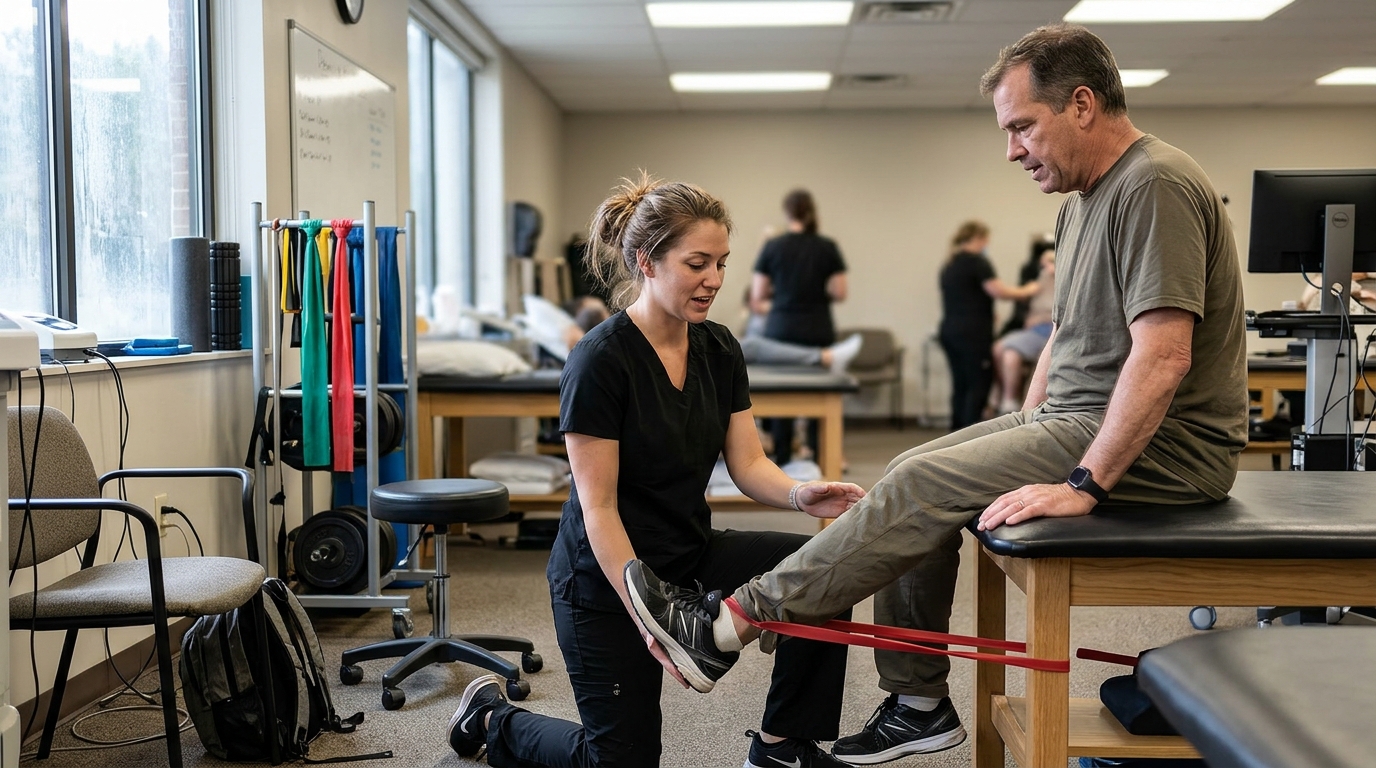
In your first year you carry out a plan of care that a physical therapist wrote, rather than writing one. Three tasks fill most of the day: helping patients perform the specific exercises in the plan of care, treating patients with techniques such as massage and stretching, and using devices and equipment such as walkers (U.S. Bureau of Labor Statistics, 2025). Alongside that, you fit gait belts, apply hot and cold packs, and set resistance on exercise bikes and pulley systems.
The rest of the job is observation and reporting. PTAs observe patients before, during and after therapy and report their status to the supervising physical therapist, and educate patients and family members about post-treatment care (U.S. Bureau of Labor Statistics, 2025). In practice that means a treatment note in the clinic's electronic record for every visit, flagging a swollen knee or a skipped exercise, and showing a spouse how to help with a home program.
New PTAs usually get straightforward caseloads first — post-operative knees and shoulders, balance work with older adults — and move to higher-acuity patients once the supervising therapist trusts their judgement. The physical therapist keeps the evaluation, diagnosis and plan of care; you cannot change a plan on your own. Physical therapist aides, by contrast, do work only indirectly related to patient care, such as cleaning and setting up the treatment area, moving patients and clerical duties (U.S. Bureau of Labor Statistics, 2025).
The physical demands are specific: standing for most of a shift, kneeling or squatting repeatedly to cue a patient's knee position, and bracing unsteady patients through sit-to-stand transfers. You will also work with people in pain who are frustrated by slow progress, and repeat the same encouragement many times a day.
Costs and Time Investment
| Cost item | Figure | Step it belongs to |
|---|---|---|
| PTA program tuition and fees | Set by the institution — compare published tuition across CAPTE-accredited programs; nearly 350 were accredited in 2017 (U.S. Bureau of Labor Statistics, 2017) | Step 3, accredited program |
| BLS certification class | A two- or three-hour hands-on class, recertified every two years (Nurse.org, undated) | Step 4, BLS |
| NPTE-PTA exam fee | $485.00, paid to the Federation of State Boards of Physical Therapy (FSBPT, undated) | Step 6, the exam |
| Prometric sitting/testing fee | $92.00, separate from the exam fee (FSBPT, undated) | Step 6, the exam |
| Missed-eligibility processing fee | $50.00 withheld from the refund if you are not made eligible by the Jurisdiction Approval Deadline, about seven days after the registration deadline (FSBPT, undated) | Step 5, state approval |
| State license application fee | Set by each state board; CareerOneStop lists state licensing boards and certification requirements (U.S. Bureau of Labor Statistics, 2025) | Step 7, state requirements |
| Continuing education for renewal | Course hours set by your state board; PTAs may need continuing education to keep a license (U.S. Bureau of Labor Statistics, 2025) | After step 7, ongoing |
For pay, check the U.S. Bureau of Labor Statistics Occupational Outlook Handbook, which publishes a median annual wage for physical therapist assistants (2025-05 data), and your state workforce agency for local figures.
Common Entry Mistakes to Avoid
- Enrolling in a program that is not CAPTE-accredited (step 3). Fix: confirm accreditation status on CAPTE's own listing before paying a deposit, since all states require a degree from an accredited program (U.S. Bureau of Labor Statistics, 2025).
- Paying the exam fee before your licensing authority approves you (steps 5 and 6). If you are not made eligible by the Jurisdiction Approval Deadline, registration closes and the fee is refunded minus a $50.00 processing fee (FSBPT, undated). Fix: submit the state application first and get approval confirmed in writing.
- Ignoring the four test windows (step 6). The NPTE-PTA is offered in January, April, July and October only (Mometrix, undated), so a May graduation can mean waiting until July. Fix: work backwards from a test date when choosing your graduation term.
- Treating retakes as unlimited (step 6). There is a lifetime limit of six attempts per exam level (Mometrix, undated). Fix: sit the exam only once you clear the 600 passing score on the 200–800 scale in full four-hour practice sessions (FSBPT documents, undated).
- Assuming one state's license covers another (step 7). Some states add an exam on state law, a background check and a minimum age of 18 (U.S. Bureau of Labor Statistics, 2025). Fix: check each board's requirements through CareerOneStop before accepting a job in a new state.
- Letting BLS lapse during your job search (step 4). Recertification is due every two years (Nurse.org, undated). Fix: diary the expiry date and rebook the two- or three-hour class a month ahead.
Frequently asked questions
How long does it take to become a PTA from a standing start?
Plan on about two years of full-time study in a CAPTE-accredited associate degree program, including supervised clinical work (U.S. Bureau of Labor Statistics, 2025). Some accredited programs run year-round and finish in as few as 18 months (Rasmussen University, 2023-05). After graduation you still need state approval, a test date in January, April, July or October, and a few weeks for results (Mometrix, undated; Vivian Health, undated).
What does the licensing exam cost and what is on it?
The NPTE-PTA fee is $485.00, with a separate $92.00 Prometric sitting fee (FSBPT, undated). The exam is 180 multiple-choice questions, 140 of them scored, over four hours, with a passing score of 600 on a 200–800 scale (FSBPT documents, undated). Content covers data collection, interventions, and the safety and effectiveness of care (Vivian Health, undated).
Does my license transfer if I move to another state?
Licensure is granted state by state, so a move usually means a new application to the destination board. Some states require an additional exam on state law, a criminal background check and a minimum age of 18 (U.S. Bureau of Labor Statistics, 2025), and all states except Colorado and Hawaii require PTAs to be licensed (Rasmussen University, 2023-05). CareerOneStop lists state licensing boards so you can compare requirements first.
Can I work in a clinic before I finish the degree?
Yes, as a physical therapist aide, which typically needs a high school diploma or equivalent plus on-the-job training lasting about one week to one month, with no state license required (U.S. Bureau of Labor Statistics, 2025). Aide duties are indirect: cleaning and setting up treatment areas, moving patients and clerical work (U.S. Bureau of Labor Statistics, 2025). It is a cheap way to confirm the setting suits you.
Is hiring demand steady for this role?
Overall employment of physical therapist assistants and aides is projected to grow 17 percent from 2025 to 2035, much faster than average, with about 24,900 openings projected each year on average over the decade (U.S. Bureau of Labor Statistics, 2025). Demand still concentrates by setting and region, so check your state workforce agency for local openings.
Sources
- U.S. Bureau of Labor Statistics — Physical Therapist Assistants and Aides : Occupational Outlook Handbook (2025-05)
- Federation of State Boards of Physical Therapy (FSBPT) — Exam Registration & Payment

Written by
Yuki covers the broader shifts in how people work: shrinking industries, growing ones, the policies that quietly decide who gets steady income. She tends to start stories with a worker's own account before zooming out.