How to Prepare for a Police Officer Interview
Most of the work happens before you sit down: your history packet, your scenarios, and a specific reason you want this department over the next one.
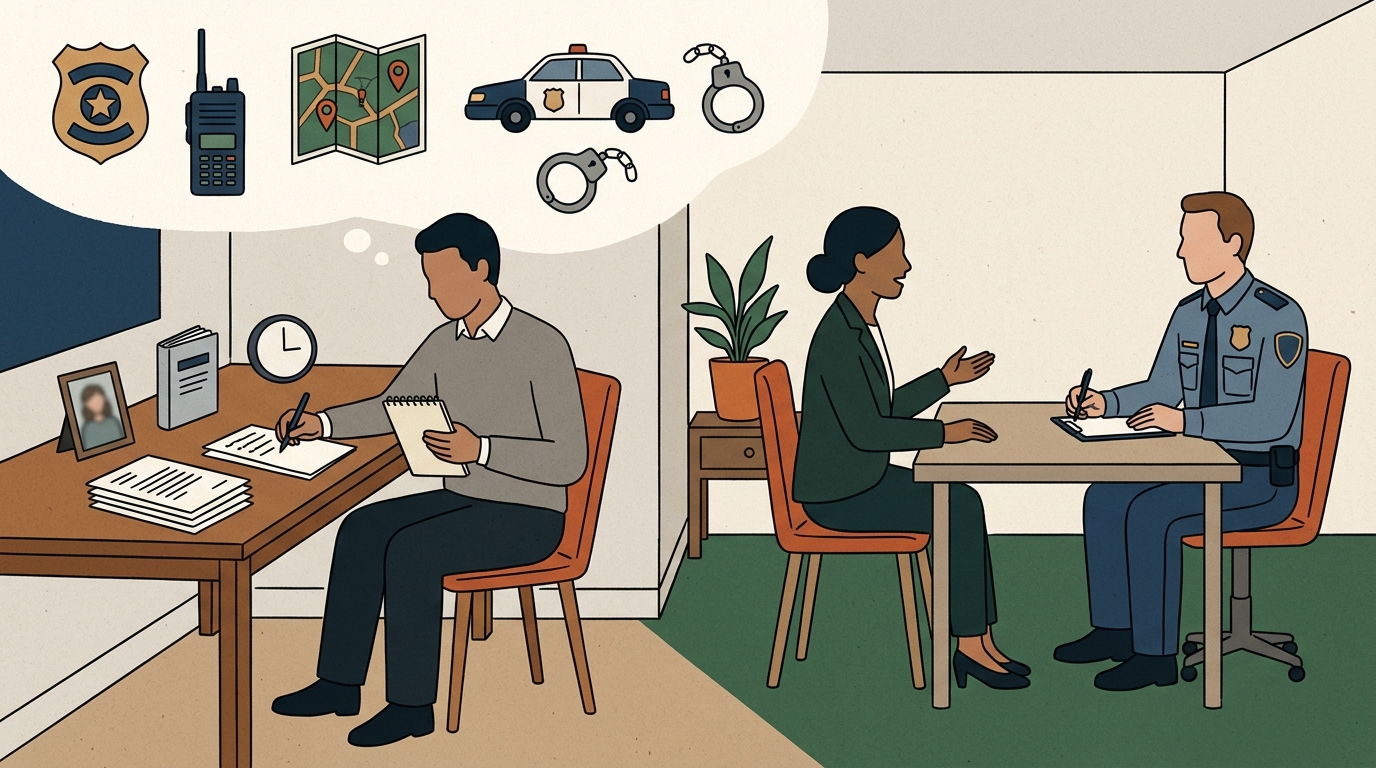
For most police officer jobs, the interview is an oral board: you appear before a panel of at least three people, often three to five, drawn from the department, other departments, human resources or the community (Go Law Enforcement; Indeed; Rasmussen University). A common panel is three or four officers — usually a lieutenant or sergeant plus one or two patrol or field training officers, sometimes with an HR or city council representative — asking two or three short-answer questions, two or three personal experience questions and three to five situational questions over 20 to 40 minutes (PoliceHow.com).
The board is scored. One widely cited guide notes that a score of 70 or above usually passes, while more than 90 improves your chances of an offer (Indeed). Rehearsed, specific answers matter more than general enthusiasm.
Step-by-Step Interview Preparation Plan
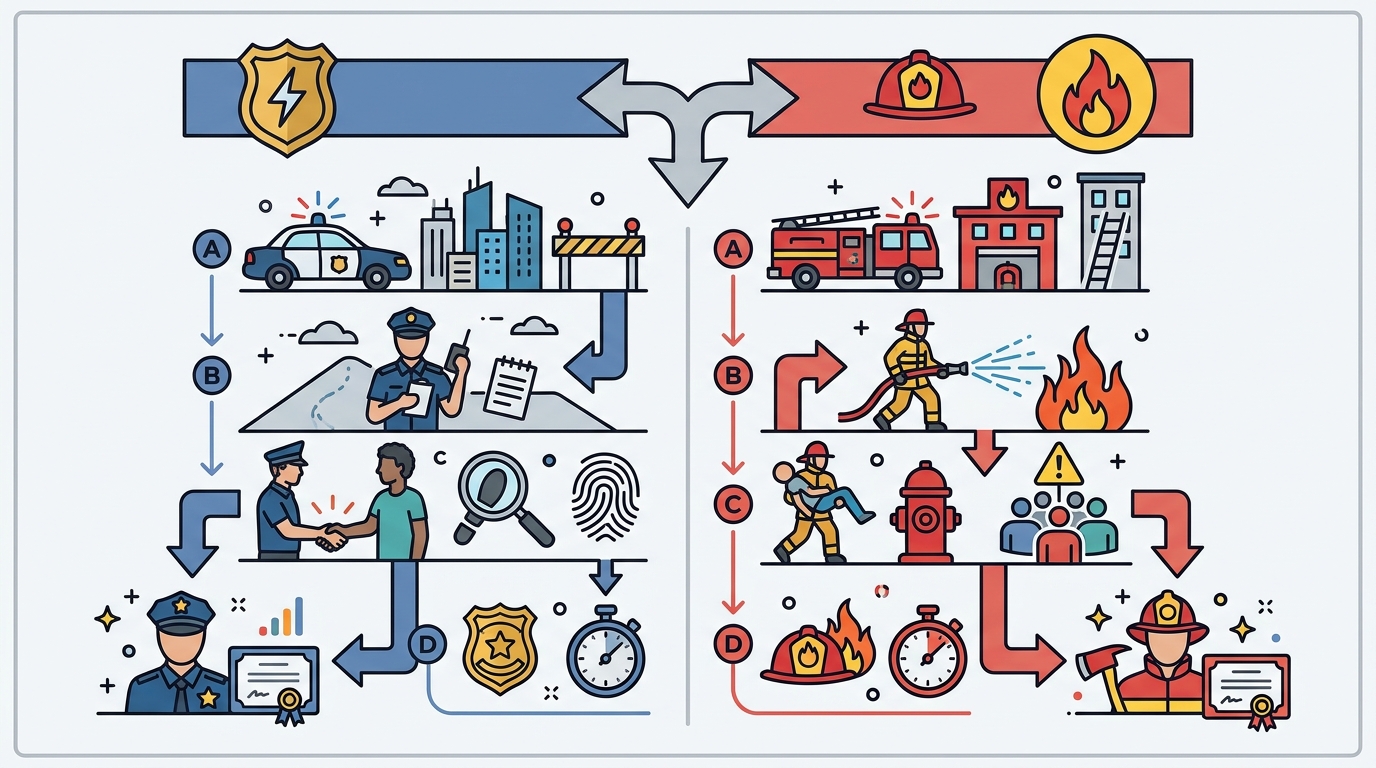
- Write out the department's hiring sequence. A common order is: minimum qualifications check, application, written or entry-level testing, physical ability testing, oral board, conditional offer or eligibility-list placement, background investigation, polygraph if used, psychological evaluation, medical exam and drug screening, final decision, academy, then field training and probation (Forever Police). It varies by state and agency: California POST sets statewide minimum standards including reading and writing ability, an oral interview, background investigation, medical evaluation and psychological evaluation, while local agencies may add a physical ability test, drug screening, higher education standards or a polygraph (Forever Police). Produce a one-page list marking which stage you are at.
- Confirm who will be in the room. Email the recruiter or background investigator and ask the panel composition. Depending on the agency it may include a police chief, lieutenant, sergeant, HR representative or a community member (Rasmussen University). Write the ranks down so a civilian member asking about community impact is not a surprise.
- Draft a 90-second opening statement. The first oral board question is typically 'Tell us a little about yourself,' and applicants are often expected to summarize their career, strengths and accomplishments, and why they want to work at that department (Police1). Write it, time it out loud, and cut anything that could apply to any agency.
- Build five incident stories in Situation–Task–Action–Result form. These answer the personal experience block. Draw on security, retail, dispatch, military, EMS, corrections, coaching or any customer-facing work.
Sample answer — 'Tell us about a time you had to deal with someone who was angry with you. What did you do?'
Situation: I worked overnight security at a hospital emergency entrance, and a man whose brother had just been admitted was shouting at the triage desk around 2am. Task: I had to keep the doorway clear and de-escalate without putting hands on anyone unless he became assaultive. Action: I moved him to the side of the lobby, used his name, told him exactly what I could and could not find out, and asked the charge nurse for an update I could relay within five minutes. I kept my hands visible and stayed outside his reach. Result: He sat down, the nurse gave him the update, no force was used and no police response was needed. My supervisor used it in the next shift briefing as the example of verbal de-escalation.
- Drill situational questions out loud. Expect three to five. Practice saying your reasoning in order: what you observe, the immediate safety concern, who you notify, what policy or supervisor you involve, and how you document it. Record yourself on questions such as 'You stop a vehicle for speeding and recognize the driver as an off-duty officer from this department. Walk us through what you do,' and 'You arrive at a domestic disturbance alone, your backup is six minutes out, and you can hear shouting inside. What are your first three actions?'
- Research the department, not policing. Produce a page of notes: the chief's name and how long they have held the post, the three most recent department items in local news, the number of patrol districts or precincts, specialist units you would want to apply to later, and the civil service or bargaining rules governing shift bidding. Add the technology you would use — ONET lists computer aided dispatch software, crime mapping software and office and presentation tools such as Microsoft PowerPoint and Visio for police and sheriff's patrol officers (ONET OnLine, 2026).
- Reconcile your answers with your background packet, then fix the logistics. Candidates must be U.S. citizens, usually at least 21, and able to meet rigorous physical and personal qualifications; a felony conviction or drug use may disqualify a candidate (U.S. Bureau of Labor Statistics, 2025). Polygraph and background topics can cover application information, criminal behavior, driving record, economic status, gambling habits, personal associates, previous employment and substance use (City of Tustin). Reread what you wrote, note the dates, and be ready to explain anything you disclosed the same way twice. Then confirm scheduling: one department has applicants review a Personal History Questionnaire with a background investigator by video conference, then attend an oral board, polygraph exam, physical fitness assessment and psychological evaluation in person across a four-day period (St. Petersburg Police Department).
Day-Before and Day-Of Checklist
- Printed copies of your application and Personal History Questionnaire, read through the night before so your dates and employers match what you say.
- Government-issued photo ID and your driver's license, plus certification cards — EMT, dispatcher, commercial license, military ID or DD-214.
- Any state certification paperwork you hold. CareerOneStop's License Finder lists 24 licenses for police and sheriff's patrol officers in the United States, including a Police Officer license issued by Oregon's Department of Public Safety Standards and Certifications Division (CareerOneStop), so bring proof if your state requires or credits one.
- Your one-page department notes: chief's name, recent news items, patrol districts, specialist units.
- Your timed opening statement and five Situation–Task–Action–Result stories on index cards, read in the car rather than the lobby.
- Interview clothing laid out the night before. Common guidance for police oral boards is to cover tattoos and body piercings, with a suit and tie, haircut and clean shave for men, and a classy dress or business suit with hair up for women (JobTestPrep, 2024).
- Gym clothes, running shoes and a water bottle left in the car if a physical fitness assessment falls in the same block of days.
- Contact details for the recruiter and background investigator saved in your phone, in case the building entrance is not where you expect.
- A plan to arrive 20 to 30 minutes early and wait in the parking area, since agency buildings usually route you through a secure lobby.
- Three references' current phone numbers and employers, confirmed by text the day before that they are reachable this week.
- A notebook and pen for the panel's names and ranks, written down as they introduce themselves so you can address them correctly.
Questions to Ask Your Interviewer
- How long is your academy, and how much field training follows before a new officer is released to solo patrol?
- What does the field training officer evaluation look like week by week, and what most often causes a trainee's program to be extended?
- Which computer aided dispatch and records management systems do officers use, and how much of a shift goes on in-car reporting?
- Do patrol officers use crime mapping data in briefings, and are they expected to bring their own district analysis?
- How are shifts and districts assigned to new officers, and how long before someone can bid for a different watch?
- Which specialist assignments — traffic, K-9, school resource, investigations — are realistically open after field training, and what do you look for in applicants?
- What is the current timeline between the oral board and the start of the background investigation for this cycle?
- How is body-worn camera footage reviewed — is it used for coaching as well as complaints?
Frequently asked questions
What should I wear to a police oral board?
Business formal. Common guidance for police oral boards is to cover tattoos and body piercings; men wear a suit and tie with a haircut and clean shave, and women wear a classy dress or business suit with hair up (JobTestPrep, 2024). Shine your shoes. If a physical fitness assessment is scheduled the same week, keep that kit in the car rather than carrying it into the board room.
How early should I arrive, and how long will the board last?
Plan to be in the parking area 20 to 30 minutes early, because agency buildings usually route visitors through a secure lobby and sign-in. The board itself commonly runs 20 to 40 minutes with a panel of three or four officers, typically a lieutenant or sergeant plus one or two patrol or field training officers and sometimes an HR or city council representative (PoliceHow.com).
How long until I hear whether I passed?
It varies by agency. One department notifies candidates within one to two weeks of its four-day testing block (St. Petersburg Police Department), while the background investigation in another city takes roughly two months on its own (City of Tustin). One Florida source puts the whole multi-phase process at three to six months (liedetectortest.com). Ask your recruiter for that agency's current timeline.
How do I prepare for the polygraph that may follow the board?
Reread your application and Personal History Questionnaire and check every date and employer before you say anything out loud. Coverage can include application information, criminal behavior, driving record, economic status, gambling habits, personal associates, previous employment and substance use (City of Tustin). A felony conviction or drug use may disqualify a candidate (U.S. Bureau of Labor Statistics, 2025), so disclose consistently rather than guessing.
Will the panel ask about pay or my education?
Education requirements for police and detectives range from a high school diploma to a college degree (U.S. Bureau of Labor Statistics, 2025), so be ready to explain how your schooling or service prepared you for academy coursework. Pay is normally set by rank, step and civil service or bargaining schedules rather than negotiated at interview — check the agency's published salary schedule and Bureau of Labor Statistics occupational data for current figures.
Sources
- U.S. Bureau of Labor Statistics — Police and Detectives : Occupational Outlook Handbook (2025)
- U.S. Bureau of Labor Statistics — Police and Detectives : Occupational Outlook Handbook (2025)
Written by
Priya turns job-market numbers into something readable, chasing the story behind a wage chart or an unemployment figure. She's most interested in what statistics miss about an actual day at work.