The Software Engineer Interview Process, Explained
From the first recruiter call to team matching, here is who runs each round, how long it takes, and what each interviewer is actually scoring you on.
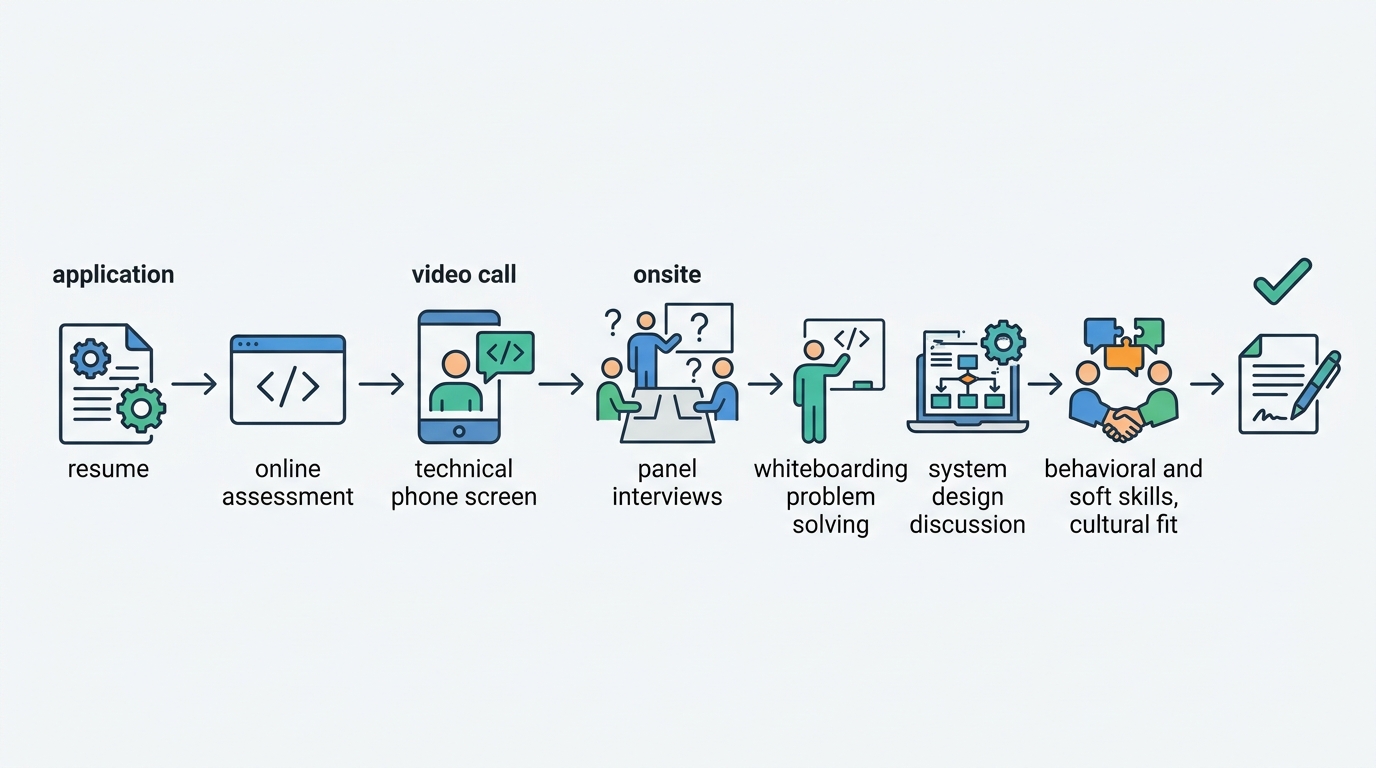
Hiring for a software engineer role usually means three to six separate conversations: a recruiter screen, a coding assessment or technical phone screen, and an onsite loop of several interviews, followed by a hiring decision. One industry guide describes the whole sequence unfolding over roughly four to six weeks (levelop.dev, undated); accounts of the largest employers put it closer to one to two months (4dayweek.io, undated).
The shape varies by employer size, team and level — a small startup may run two rounds in a fortnight, while a large technology company may run five and add a team-matching step before any offer.
Overview of the Software Engineer Hiring Process
Plan for three to six distinct rounds, depending on the employer and the level. One described software engineer format lists four main parts: phone screens (usually two), an online coding assessment, sometimes a take-home assignment, and an onsite of three to five interviews (Prepfully, undated). Another describes an onsite of four to five interviews, usually an hour each, with feedback feeding the hiring decision (Medium (geekculture), undated). A third describes a recruiter call, a hiring manager phone screen, one or two technical phone screens, and an onsite or virtual loop of four to eight interviews, with some teams splitting it across two days (techscreen.app, undated).
On timing, one guide maps recruiter screen, online assessment, technical phone screen, onsite loop and offer negotiation across roughly four to six weeks (levelop.dev, undated); another describes a large employer's process spanning one to two months (4dayweek.io, undated).
Two things change what you face. Level: system design rounds are usually reserved for mid-level and senior roles, where you design a service such as a URL shortener and discuss scaling, storage and trade-offs (CrackInterviewAI, undated). Employer: large technology companies may add team matching after the hiring decision and before the offer (CrackInterviewAI, undated). Competition can be brutal — one account puts the rejection rate for one large employer's software engineer interview at around 99.8% (4dayweek.io, undated).
Typical Stages of the Interview Process
- Recruiter screen — 20 to 30 minutes, run by a recruiter or sourcer. Covers background, technical skills and interest in the position (4dayweek.io, undated); another account of the same employer's process describes about 30 minutes (Leetcode Wizard, undated).
- Online coding assessment — timed problems on a hosted platform, auto-graded or reviewed by an engineer. Some employers substitute a take-home assignment instead (Prepfully, undated).
- Technical phone screen — 45 to 60 minutes with a practising engineer. A live conversation over a shared editor such as CoderPad, covering one or two problems (levelop.dev, undated).
- Hiring manager conversation — 30 to 45 minutes with the manager who owns the role. Not universal; one described process places it straight after the recruiter call (techscreen.app, undated). Covers scope, roadmap and how you work.
- Onsite or virtual loop — three to five interviews of about 45 to 60 minutes each, run by engineers, a technical lead and often a cross-team interviewer. Rounds cover coding, system design for mid-level and above, and behavioral questions (4dayweek.io, undated; two coding, one system design, one behavioral and one leadership round, ophyai.com, 2026).
- Hiring decision, team matching and offer — days to weeks, handled by a hiring committee and the recruiter. Interview feedback is pooled into the decision (Medium (geekculture), undated), and some employers add team matching before an offer (CrackInterviewAI, undated).
Interview Rounds at a Glance
| Stage | Format | Typical Duration | What It Evaluates |
|---|---|---|---|
| Recruiter screen | Call with a recruiter | 20-30 minutes (4dayweek.io, undated) | Background, technical skills, interest in the role |
| Online coding assessment | Timed problems on a hosted platform | Usually 60-120 minutes | Correctness, complexity, finishing under time pressure |
| Take-home assignment (sometimes used) | Small feature built in your own time | Hours to days | Code structure, tests, README, scope judgement |
| Technical phone screen | Live coding with an engineer in a shared editor | 45-60 minutes, one or two problems (levelop.dev, undated) | Algorithmic problem-solving, clarifying questions, trade-offs (4dayweek.io, undated) |
| Hiring manager conversation | Video call with the role's manager | 30-45 minutes | Fit with the team's roadmap, ownership, handling ambiguity |
| Coding rounds in the loop | Whiteboard or shared editor with engineers | About 45 minutes each (4dayweek.io, undated) | Data structures, algorithms, testing your own solution |
| System design round (mid-level and above) | Diagramming with a senior engineer or technical lead | 45-60 minutes | Designing a service such as a URL shortener; scaling, storage, trade-offs (CrackInterviewAI, undated) |
| Behavioral round | Conversation with an engineer or manager | About 45 minutes | Past-behavior answers in STAR form, collaboration, conflict |
| Team matching and offer | Calls with recruiter and prospective managers | Days to weeks | Mutual fit with a specific team and its stack |
Questions You're Likely to Be Asked at Each Stage
Recruiter screen
Question
"What interests you about this role?"
Sample questions here are described as including "Tell me about yourself" and "What interests you about this role?" (Prepfully, undated). The recruiter checks that you can describe your work plainly and that your interest is concrete. Name the service you want to work on and the technology listed in the posting.
Online coding assessment
Question
"Given an array of integers and a target sum, return the indices of two numbers that add up to the target. What is the time and space complexity of your approach?"
Auto-graded assessments test whether you reach a correct, reasonably efficient solution with no interviewer to nudge you. Hidden tests usually include empty inputs, duplicates and very large arrays, so list edge cases before you start typing.
Technical phone screen
Question
"Before you start coding, walk me through how you're thinking about this problem."
Interviewers here are said to care whether you take time to understand the problem, ask clarifying questions, state assumptions and discuss trade-offs rather than just producing working code (levelop.dev, undated). Say aloud what you assume about input size and null values, then name the data structure you chose and its cost.
Hiring manager conversation
Question
"Tell me about a time you shipped something that didn't work as expected in production. What did you do?"
The manager is testing ownership when something breaks on your watch. Pick an incident where you can name the signal that alerted you — an error-rate alarm, a failed deploy, a customer ticket — and the change you made afterwards, such as a new test or a rollback step.
Onsite or virtual loop
Question
"Design a URL shortener. Assume it needs to handle a large volume of reads and far fewer writes."
System design rounds are usually for mid-level and senior roles and involve exactly this kind of service, with scaling, storage and trade-offs discussed (CrackInterviewAI, undated). State the read-to-write ratio you assume, sketch the API, then justify key generation and caching. Behavioral rounds in the same loop use STAR-form answers (CrackInterviewAI, undated):
Sample STAR answer — "Tell me about a time you disagreed with a technical decision"
Situation: my team planned to move a billing service onto a new message queue two weeks before a release. Task: I owned the retry logic and believed the migration would hide failed payment events. Action: I built a replay harness, ran our top ten failure cases against both queues, and brought the comparison to the design review. Result: we shipped on the existing queue, moved the migration a quarter later, and kept the harness as a regression test.
Hiring decision, team matching and offer
Question
"Which of these teams would you want to join, and why that one?"
Where team matching is used, you are choosing, not just accepting. Ask what the team deploys in a normal week, who carries the pager, and how much of the backlog is migration work versus new features — then say which answer decided it.
Frequently asked questions
Do I need a particular degree to get through the screen?
Software developers typically need a bachelor's degree in computer and information technology or a related field such as engineering or mathematics, and some employers prefer a master's degree (U.S. Bureau of Labor Statistics, undated). Requirements vary by employer and state, so read the posting's stated minimum. "Software Engineer" is a reported job title for the O*NET occupation Software Developers, 15-1252.00 (CareerOneStop, undated).
What should I ask my interviewers?
Ask the technical lead how code reaches production — review requirements, test coverage expectations, deploy frequency. Ask the manager which services the team owns and what the on-call rotation looks like. Ask your peer interviewer what the last significant design document argued about.
How much of the job is solo coding?
Less than candidates expect. O*NET's Work Context data for Software Developers reports that 46% of respondents said coordinating or leading others in accomplishing work activities is 'Very important,' and 35% reported 'Constant contact with others' (O*NET OnLine, U.S. Dept. of Labor, 2026). That is why behavioral rounds carry real weight.
Sources
- U.S. Bureau of Labor Statistics — Software Developers, Quality Assurance Analysts, and Testers : Occupational Outlook Handbook
- CareerOneStop — Occupation Profile for Software Developers

Written by
Yuki covers the broader shifts in how people work: shrinking industries, growing ones, the policies that quietly decide who gets steady income. She tends to start stories with a worker's own account before zooming out.