Police Officer vs Firefighter: Which Career Fits You
The hiring steps, shift patterns, physical demands and daily tools differ more than most applicants expect — here is how to tell which one suits you.
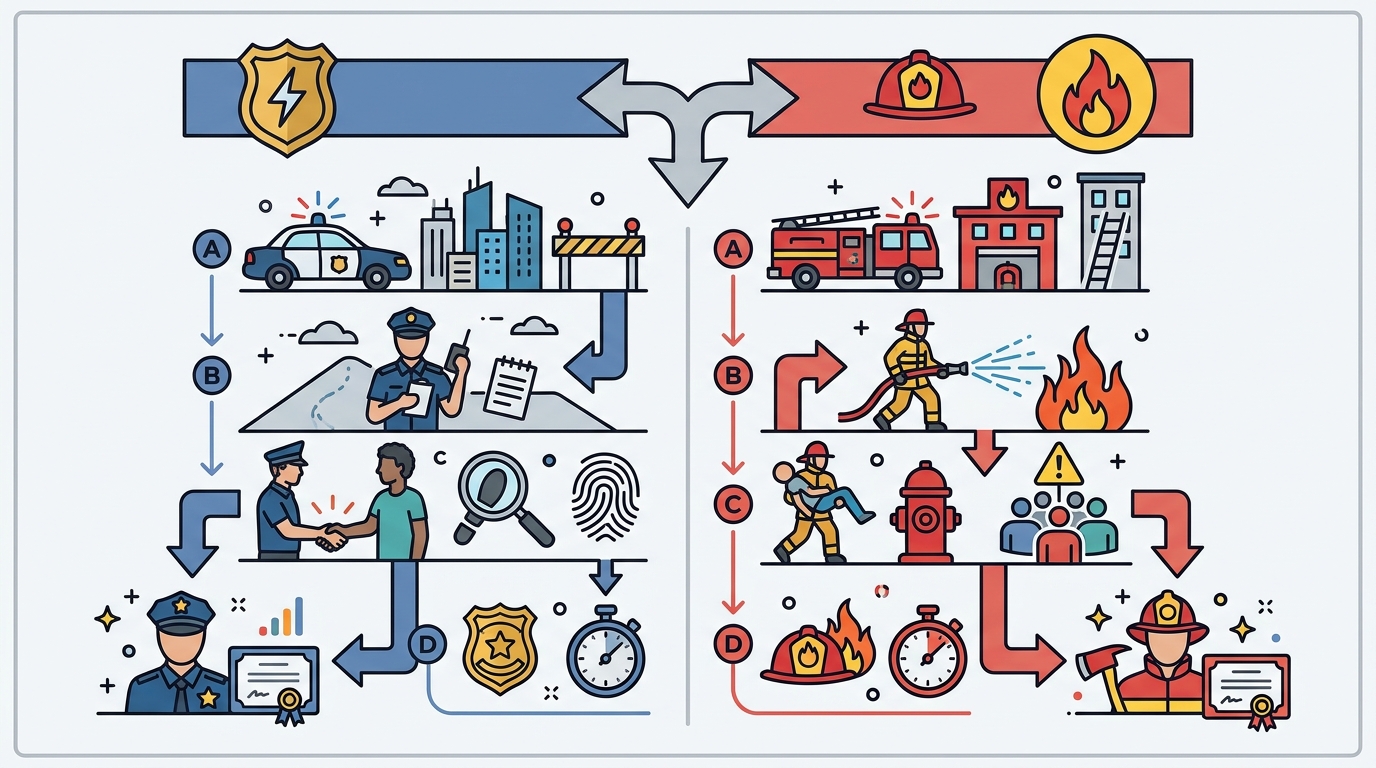
Police officers and firefighters are both sworn public safety jobs, usually on government payrolls, and both involve shift work, overtime and real physical risk. The practical difference is what fills the hours between emergencies: patrol officers spend much of a shift driving an assigned area, making traffic stops, collecting evidence and writing reports that may end up in court, while firefighters spend much of theirs at a station maintaining equipment and running medical calls, often on 24-hour shifts followed by 48 or 72 hours off (U.S. Bureau of Labor Statistics, 2025).
If you want a predictable block of days off and work best inside a tight crew, firefighting usually fits better. If you prefer independent decision-making, investigation and paperwork that carries legal weight, policing usually fits better.
Side-by-Side Comparison
The two jobs overlap on emergency response and diverge almost everywhere else. Use this table as the frame for the rest of the guide.
| Dimension | Police Officer | Firefighter |
|---|---|---|
| Median pay | Published as a median annual wage for police and detectives in the BLS Occupational Outlook Handbook (U.S. Bureau of Labor Statistics, 2025); look up the current figure there, and expect paid overtime on top, which is common in the occupation (U.S. Bureau of Labor Statistics, 2025). | Published as a median annual wage for firefighters in the BLS Occupational Outlook Handbook (U.S. Bureau of Labor Statistics, 2025); look up the current figure there, and expect overtime, which is common because of long shift cycles (U.S. Bureau of Labor Statistics, 2025). |
| Typical schedule | Full time, with shift work necessary to protect the public at all times and paid overtime common, including court appearances on days off (U.S. Bureau of Labor Statistics, 2025). | Long periods on duty, commonly a 24-hour shift followed by 48 or 72 hours off, with overtime common (U.S. Bureau of Labor Statistics, 2025). |
| Education required | Ranges from a high school diploma to a college degree; some federal agencies and departments require college coursework or a degree (U.S. Bureau of Labor Statistics, 2025). | Hiring centers on Firefighter I and II certification to the NFPA 1001 standard, accredited by IFSAC or the Pro Board, plus EMT certification through the National Registry of Emergency Medical Technicians in most departments. |
| Training after hire | On-the-job training is typically needed in addition to academy instruction (U.S. Bureau of Labor Statistics, 2025); recruits ride with a field training officer before solo patrol. | On-the-job training is typically needed (U.S. Bureau of Labor Statistics, 2025); probationary firefighters drill on hose lays, ladders and SCBA use at the station. |
| Physical demands | Police and sheriff's patrol officers and transit and railroad police have some of the highest rates of injuries and illnesses of all occupations (U.S. Bureau of Labor Statistics, 2025); add foot pursuits, physical restraint and routine verbal confrontation at traffic stops. | Protective gear worn on emergencies can be very heavy and hot (U.S. Bureau of Labor Statistics, 2025); add dragging charged hose lines, raising ground ladders and lifting patients onto stretchers. |
| Job growth, 2025-35 | BLS projects employment growth for police and detectives over 2025-35 (U.S. Bureau of Labor Statistics, 2025); check the Occupational Outlook Handbook for the current percentage and projected change in jobs. | BLS projects employment growth for firefighters over 2025-35 (U.S. Bureau of Labor Statistics, 2025); check the Occupational Outlook Handbook for the current percentage and projected change in jobs. |
| Typical work setting | Mostly government employment outside state and local education and hospitals (U.S. Bureau of Labor Statistics, 2025); the shift is spent in a patrol vehicle, at scenes and in courtrooms. | Mostly local government employment outside education and hospitals (U.S. Bureau of Labor Statistics, 2025); the shift is spent at a staffed fire station, where crews sleep, eat and do nonemergency tasks between calls (U.S. Bureau of Labor Statistics, 2025). |
| Core written output | Detailed incident and arrest reports that can be challenged in court, plus sworn testimony (U.S. Bureau of Labor Statistics, 2025). | Written incident reports for fires and medical calls, plus apparatus and equipment checks (U.S. Bureau of Labor Statistics, 2025). |
A Day in Each Role
A patrol officer starts with roll call, takes a marked cruiser out of the lot and checks the radio and in-car camera before clearing for calls. The shift is a mix of dispatched runs and self-initiated work: patrolling an assigned area, running traffic stops and responding to emergency and nonemergency calls (U.S. Bureau of Labor Statistics, 2025). On a burglary call, the officer photographs the point of entry, collects and secures evidence, and canvasses neighbors. Most of what happens then gets typed into a records management system on the mobile data terminal, because the report has to survive a defense attorney reading it line by line. Officers also testify in court (U.S. Bureau of Labor Statistics, 2025), often on a scheduled day off, and spend part of most shifts on verbal de-escalation with people who do not want them there.
A firefighter starts at shift change by checking the engine: SCBA cylinder pressures, hose loads, ladders, saws and the medical jump bag. Between calls the crew trains, inspects hydrants, cleans and maintains equipment, cooks, and sleeps at the station when nothing is running (U.S. Bureau of Labor Statistics, 2025). When the tones drop, the job is to drive firetrucks and other emergency vehicles to the scene, put out fires using hoses and pumps, rescue occupants, and treat sick or injured people (U.S. Bureau of Labor Statistics, 2025). Most calls in many departments are medical: blood pressure cuff, cardiac monitor, lifting a patient down a staircase. Fires mean working in turnout gear and SCBA that is very heavy and hot (U.S. Bureau of Labor Statistics, 2025), then overhaul, hose reloading and a written incident report.
Choose Police Officer If...
- You want to work largely alone and make your own calls — a patrol shift is mostly one officer in one cruiser covering an assigned area, not a crew acting together.
- You are interested in investigation and the legal system, because collecting and securing evidence, writing detailed reports and testifying in court are core duties (U.S. Bureau of Labor Statistics, 2025).
- You are comfortable with routine verbal confrontation and physical restraint, and you accept that police and sheriff's patrol officers have some of the highest rates of injuries and illnesses of all occupations (U.S. Bureau of Labor Statistics, 2025).
- You want a go-home-every-day schedule rather than sleeping at work; police shift work covers all hours, but you are not on duty for 24 straight hours (U.S. Bureau of Labor Statistics, 2025).
- You are willing to pursue college coursework or a degree, which some federal agencies and departments require (U.S. Bureau of Labor Statistics, 2025), and which opens detective and federal investigator paths.
Choose Firefighter If...
- You want long blocks of time off, because a 24-hour shift is commonly followed by 48 or 72 hours off duty (U.S. Bureau of Labor Statistics, 2025) — useful for a second job, school or childcare.
- You work best as part of a permanent crew, eating, training and sleeping at the same station rather than patrolling solo.
- You like mechanical and hands-on work: driving firetrucks, operating pumps and hoses, and cleaning and maintaining equipment are daily duties (U.S. Bureau of Labor Statistics, 2025).
- You can sustain heavy exertion in protective gear that is very heavy and hot (U.S. Bureau of Labor Statistics, 2025), including lifting patients and raising ladders.
- You would rather earn a skills credential than a degree — Firefighter I and II to NFPA 1001 plus a National Registry of Emergency Medical Technicians EMT certification is the usual package.
Getting Started in Either Path
Both paths run through a competitive hiring process: written exam, physical ability test, oral board, background investigation, polygraph in many agencies, and medical and psychological screening. Requirements are set state by state and department by department, so read the posted job announcement before you spend money on training.
| Step | Police Officer | Firefighter |
|---|---|---|
| Typical entry credential | State Peace Officer Standards and Training (POST) basic academy certification, earned either after hire or, in some states, at a self-sponsored academy; some federal agencies and departments require college coursework or a degree (U.S. Bureau of Labor Statistics, 2025). | Firefighter I and Firefighter II certification to NFPA 1001, accredited by IFSAC or the Pro Board, plus EMT certification through the National Registry of Emergency Medical Technicians; paramedic certification is required by some departments. |
| Typical time to entry | Hiring and background investigation commonly run 6 to 12 months; a basic academy commonly runs about 4 to 6 months full time, followed by roughly 3 to 6 months of field training and a one-year probation. | Firefighter I/II and EMT coursework commonly takes 3 to 9 months; a department recruit academy commonly runs 10 to 16 weeks, followed by a one-year probation. Paramedic school adds roughly 12 to 18 months. |
| First job title | Police Officer Recruit, then Probationary Police Officer; Deputy Sheriff Trainee at county agencies. | Firefighter Recruit, then Probationary Firefighter or Firefighter/EMT. |
Frequently asked questions
Which pays more, police officer or firefighter?
The U.S. Bureau of Labor Statistics publishes a median annual wage for police and detectives and a separate median for firefighters (2025); check both occupation pages in the Occupational Outlook Handbook for the current figures, because rankings shift and locality matters more than the national median. Pay for both is usually set by a public salary schedule with steps for years of service, plus overtime, which is common in each occupation (U.S. Bureau of Labor Statistics, 2025). Police overtime often comes from court appearances and callbacks; firefighter overtime often comes from covering 24-hour shifts. A city police officer and a city firefighter in the same jurisdiction are frequently on comparable scales, so compare specific postings rather than national averages.
Which job is harder on the body?
They are hard in different ways. Police and sheriff's patrol officers have some of the highest rates of injuries and illnesses of all occupations (U.S. Bureau of Labor Statistics, 2025), largely from foot pursuits, restraint and roadside work. Firefighters face sustained exertion in protective gear that can be very heavy and hot (U.S. Bureau of Labor Statistics, 2025), plus lifting patients on medical calls. If you have a back or knee history, get specific about which set of demands you can repeat for twenty years.
Which offers more schedule flexibility?
Firefighters usually get larger continuous blocks off, since a 24-hour shift is commonly followed by 48 or 72 hours off duty (U.S. Bureau of Labor Statistics, 2025), which makes college classes or a side business easier to schedule. Police officers work full-time shifts covering every hour of the day, with paid overtime common (U.S. Bureau of Labor Statistics, 2025), and often bid shifts by seniority, so new officers tend to get nights and weekends. The trade is that a firefighter sleeps at work while a police officer goes home after every shift.
Which career advances faster?
Police departments typically offer both a rank ladder — sergeant, lieutenant and above — and lateral specialist moves into detective, criminal investigator, K-9 or traffic units, which is why some federal agencies and departments look for college coursework or a degree (U.S. Bureau of Labor Statistics, 2025). Fire departments promote through driver/engineer, lieutenant, captain and chief officer, with specialist tracks in paramedicine, hazardous materials, technical rescue and fire investigation. Promotion in both usually requires time in grade plus a competitive exam and assessment center, so speed depends on the department's size and turnover rather than on the career itself.
Sources
- U.S. Bureau of Labor Statistics — Police and Detectives : Occupational Outlook Handbook (2025)
- U.S. Bureau of Labor Statistics — Firefighters : Occupational Outlook Handbook (2025)

Written by
Desmond writes about the mechanics of job hunting — resumes, interviews, the strange rituals of being evaluated by strangers. He's drawn to the gap between how hiring is supposed to work and how it actually happens.