How to Become an EMT: Step-by-Step Guide
Short state-approved course, two exams, one state license: here is what EMT training costs, how long each stage takes, and what the first year on a rig asks.
Becoming an EMT means finishing a state-approved training course, passing a cognitive exam and a hands-on skills evaluation, then getting licensed by the state where you plan to work. Most people finish EMT-Basic training in under a year (U.S. Bureau of Labor Statistics, 2025), and the typical entry-level education is a postsecondary nondegree award rather than a degree (U.S. Bureau of Labor Statistics, 2025).
It suits people who stay organised under noise and pressure, can lift and carry patients with a partner, and don't mind that a shift can run 12 or 24 hours. If that fits, the path below is short enough to start this year.
Step-by-Step Path to This Career
- Finish high school and get a CPR/BLS card (1 day to a few weeks). EMT program applicants usually need a high school diploma or equivalent plus certification in CPR and basic life support, though entry requirements vary by state (U.S. Bureau of Labor Statistics, 2025). A BLS provider course is typically a single session; book it before applications open rather than after.
- Hold a current driver's license (before you apply). Employers typically require EMT candidates to have a driver's license and may prefer ambulance driver certification (U.S. Bureau of Labor Statistics, 2025). If your record has recent violations, deal with that early — insurance rules at ambulance services are stricter than the licensing rules.
- Enrol in a state-approved EMT course (about 3 to 4 months). A typical program is around 120 hours over about 3 months (Elite Ambulance); some run longer, such as a 16-week, 280-hour classwork, lab and clinical program (Emergent Health Partners). EMT-Basic programs usually take less than 1 year, while EMT-Intermediate can take up to 2 years (U.S. Bureau of Labor Statistics, 2025).
- Pass the NREMT cognitive exam (schedule 2 to 6 weeks after your course ends). The National Registry of Emergency Medical Technicians charges $104 per attempt, including every retake (MedPreps, 2026). Some states offer an alternative — North Carolina, for example, lets candidates choose the NC State EMT Cognitive Examination or the NREMT Cognitive Examination (statelicensed.org).
- Pass the psychomotor (skills) evaluation (1 day). This is a separate hands-on test of stations such as patient assessment, airway management and spinal motion restriction (statelicensed.org; freeemttest.org). Most students sit it within weeks of the written exam while skills are fresh.
- Apply for your state EMT license (2 to 8 weeks of processing). All states require EMTs to be licensed in the state where they work, and requirements vary by state (U.S. Bureau of Labor Statistics, 2025). CareerOneStop is the listed source for state licensing board and certification information (U.S. Bureau of Labor Statistics, 2025); North Carolina, as one example, requires 192 training hours with an upfront cost of $172 (statelicensed.org).
- Get hired and complete field orientation (1 to 2 years to full competence). EMT is classified in Job Zone Three, 'Medium Preparation Needed,' where employees usually need one or two years of on-the-job experience and informal training alongside experienced workers (O*NET OnLine). Employment was 284,100 in 2025 with about 18,200 openings projected each year on average (U.S. Bureau of Labor Statistics, 2025).
- Recertify, then decide about paramedic school (every 2 years; 1 to 2 years extra for paramedic). NREMT certification runs on a two-year cycle requiring 40 hours of continuing education under the National Continued Competency Program, or retaking the cognitive exam (certwright.com, 2026). Paramedics typically need work experience as an EMT before entering a paramedic program (U.S. Bureau of Labor Statistics, 2025); their median annual wage was $60,600 in May 2025 (U.S. Bureau of Labor Statistics, 2025).
Education and Training Options Compared
| Path | Time | Typical Cost | Outcome |
|---|---|---|---|
| Community college career certificate | Usually one semester of EMT-Basic coursework | $1,246 estimated for the Emergency Medical Technician-Basic Certificate (College of Lake County) | Career certificate plus eligibility to sit the NREMT cognitive and psychomotor exams |
| Hybrid course run by an ambulance service | 16 weeks, 280 classwork, lab and clinical hours, asynchronous online with in-person labs (Emergent Health Partners) | Set by the provider; comparable programs run $800 to $1,500 (Elite Ambulance) | EMT-Basic course completion with clinical hours already logged on an ambulance |
| Private accelerated course | About 3 months for a 120-hour program (Elite Ambulance) | $800 to $1,500 average enrolment cost (Elite Ambulance) | Course completion certificate and exam eligibility, fastest route to testing |
| State-specified hour requirement (North Carolina example) | 192 training hours (statelicensed.org) | $172 upfront (statelicensed.org) | NC EMT licensure after the chosen cognitive exam plus the psychomotor exam |
What You'll Actually Be Doing Once You Start
For the first 6 to 12 months you are the second set of hands on a two-person ambulance crew, and much of the shift is not emergency medicine. You'll drive or navigate, check the rig at the start of shift against an inventory sheet, restock the airway bag, and swap out oxygen cylinders. Expect to spend real time cleaning the stretcher and decontaminating the patient compartment between calls.
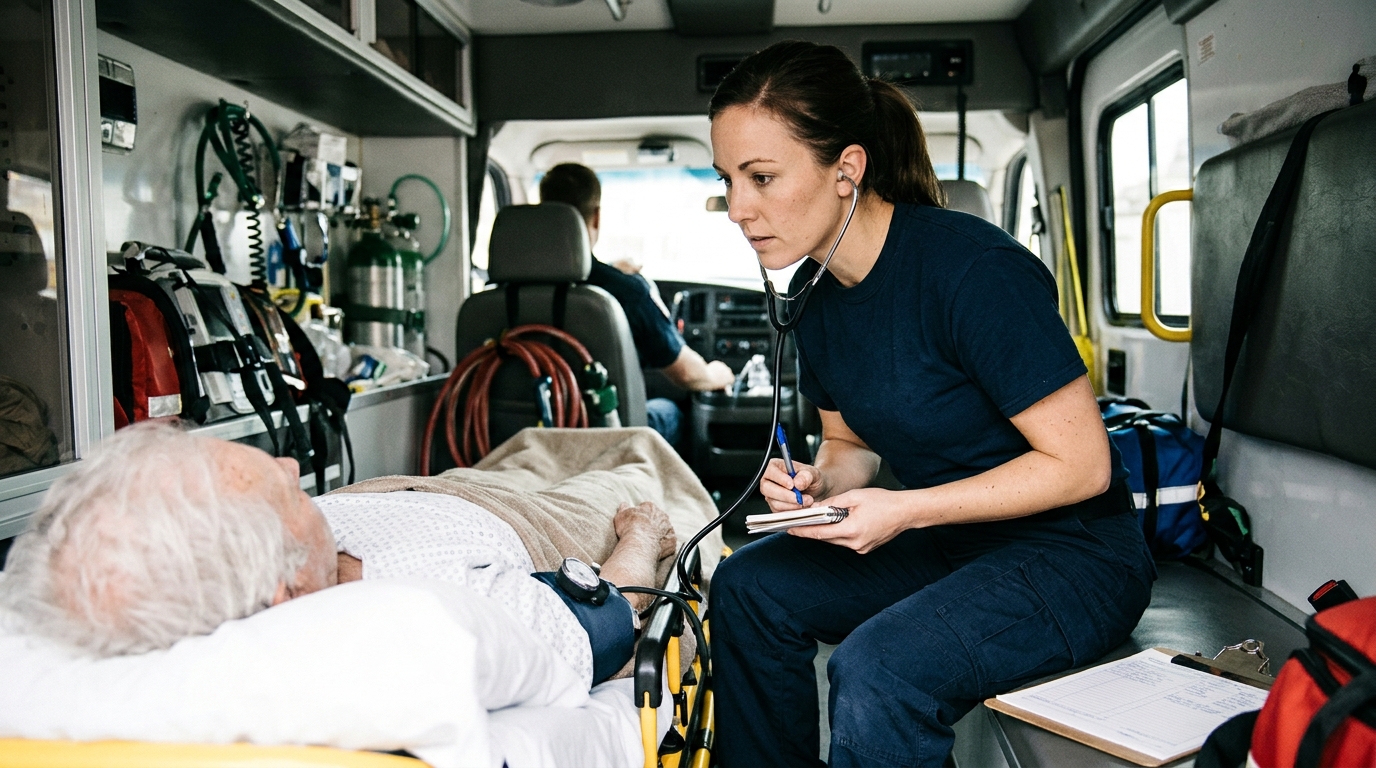
On calls, your core work is administering first aid treatment or life support care to sick or injured people in prehospital settings (O*NET OnLine). In practice that means taking vital signs with a blood pressure cuff and pulse oximeter, applying oxygen, running an automated external defibrillator and bag-valve mask during a cardiac arrest, fitting a cervical collar, splinting, and moving patients by stretcher and stair chair — often down a narrow staircase with one partner. You'll also write the patient care report in your service's ePCR software, and new EMTs are usually slowest at this: a thorough narrative takes practice.
The physical and emotional specifics are worth naming. You will lift and carry adult patients with one partner, work 12- or 24-hour shifts that can include overnight calls, and be present at deaths, serious trauma and overdoses. You will also meet verbal hostility from intoxicated or frightened patients.
What senior crew members do that you won't: a paramedic on the same truck starts IV lines, interprets a 12-lead cardiac monitor, performs advanced airway procedures and administers medications under protocol. Paramedics typically need EMT work experience first (U.S. Bureau of Labor Statistics, 2025). Field training officers and supervisors also sign off new hires, manage scenes with multiple agencies, and handle the calls where protocols conflict.
Costs and Time Investment
| Cost or time item | Step it belongs to | Specific figure |
|---|---|---|
| Private EMT course tuition | Step 3 (state-approved course) | $800 to $1,500 for a 120-hour program (Elite Ambulance) |
| Community college certificate tuition and fees | Step 3 (state-approved course) | $1,246 estimated (College of Lake County) |
| Classroom, lab and clinical hours | Step 3 (state-approved course) | 120 hours over about 3 months (Elite Ambulance), or 280 hours over 16 weeks (Emergent Health Partners) |
| NREMT cognitive exam fee | Step 4 (cognitive exam) | $104 per attempt, charged again for every retake (MedPreps, 2026) |
| State training hours and upfront licensure cost (North Carolina example) | Steps 3 and 6 (course and state license) | 192 hours and $172 upfront (statelicensed.org) |
| Continuing education for recertification | Step 8 (maintaining certification) | 40 hours every 2 years under the National Continued Competency Program (certwright.com, 2026) |
Common Entry Mistakes to Avoid
- Enrolling in a course that isn't state-approved. The path requires a state-approved course before you can test (freeemttest.org), and all states license EMTs with requirements that vary by state (U.S. Bureau of Labor Statistics, 2025). Fix: confirm approval with your state EMS office — CareerOneStop is the listed source for state licensing board and certification information (U.S. Bureau of Labor Statistics, 2025) — before you pay a deposit.
- Sitting the NREMT cognitive exam unprepared because it feels like a formality. At $104 per attempt, with the fee charged for every retake (MedPreps, 2026), three attempts cost more than a quarter of a $1,246 certificate program (College of Lake County). Fix: book the exam 2 to 4 weeks after your course ends and work through full-length practice tests in that window.
- Treating the psychomotor exam as an afterthought. It is a separate skills evaluation from the written test (statelicensed.org). Fix: rehearse assessment stations out loud with a classmate while you still have access to the program's lab equipment and manikins.
- Skipping the CPR/BLS card before applying. Programs usually require a high school diploma or equivalent plus CPR and basic life support certification at entry (U.S. Bureau of Labor Statistics, 2025). Fix: complete a BLS provider course first so an application isn't rejected over a missing card.
- Ignoring the driving requirement. Employers typically require a driver's license and may prefer ambulance driver certification (U.S. Bureau of Labor Statistics, 2025). Fix: pull your own driving record before you apply and ask services what they will accept.
- Letting recertification creep up on you. NREMT runs a two-year cycle needing 40 hours of continuing education across national, state/local and individual-choice components, or retaking the cognitive exam (certwright.com, 2026), and attending training classes to maintain licensure is a listed EMT task (O*NET OnLine). Fix: log hours in a spreadsheet each quarter instead of scrambling in the final month.
Frequently asked questions
How much will it cost me to get certified?
Budget for tuition plus exam fees. A 120-hour course averages $800 to $1,500 (Elite Ambulance), a community college certificate has been estimated at $1,246 (College of Lake County), and the NREMT cognitive exam is $104 per attempt including retakes (MedPreps, 2026). State fees sit on top — North Carolina lists $172 upfront alongside its 192 training hours (statelicensed.org).
How long does it take from signing up to working on an ambulance?
EMT-Basic programs typically take less than 1 year, and EMT-Intermediate up to 2 years (U.S. Bureau of Labor Statistics, 2025). A common pattern is about 3 months of coursework for 120 hours (Elite Ambulance), or 16 weeks for a 280-hour hybrid program (Emergent Health Partners), then a few more weeks for testing and state licensing. Reaching full competence on the job takes another one to two years of on-the-job experience (O*NET OnLine).
Does my certification transfer if I move to another state?
All states require EMTs to be licensed in the state where they work, and requirements vary by state (U.S. Bureau of Labor Statistics, 2025). Some states accept the NREMT cognitive exam while others offer their own — North Carolina lets candidates choose between the NC State EMT Cognitive Examination and the NREMT Cognitive Examination (statelicensed.org). Check the destination state's EMS licensing board directly; CareerOneStop is the listed source for that information (U.S. Bureau of Labor Statistics, 2025).
Do I need to work as an EMT before becoming a paramedic?
Paramedics typically need work experience as an EMT before entering a paramedic education program (U.S. Bureau of Labor Statistics, 2025). The pay difference is the usual reason people make the move: the median annual wage was $44,470 for EMTs and $60,600 for paramedics in May 2025 (U.S. Bureau of Labor Statistics, 2025).
Are there enough jobs to make this worth starting?
Employment of EMTs and paramedics was 284,100 in 2025 and is projected to grow 6 percent from 2025 to 2035, faster than the average for all occupations, with about 18,200 openings projected each year on average over the decade (U.S. Bureau of Labor Statistics, 2025). Openings are concentrated where call volume is high, so check postings from 911 services and private ambulance companies in your own county before committing to tuition.
Sources
- U.S. Bureau of Labor Statistics — EMTs and Paramedics : Occupational Outlook Handbook (2025)
- O*NET OnLine (National Center for O*NET Development) — 29-2042.00 - Emergency Medical Technicians

Written by
Priya turns job-market numbers into something readable, chasing the story behind a wage chart or an unemployment figure. She's most interested in what statistics miss about an actual day at work.