Is a Career in Nursing Right for You?
A look at the shifts, the physical load, the licensing exam and the temperament bedside nursing asks for, so you can judge the fit before you enroll.
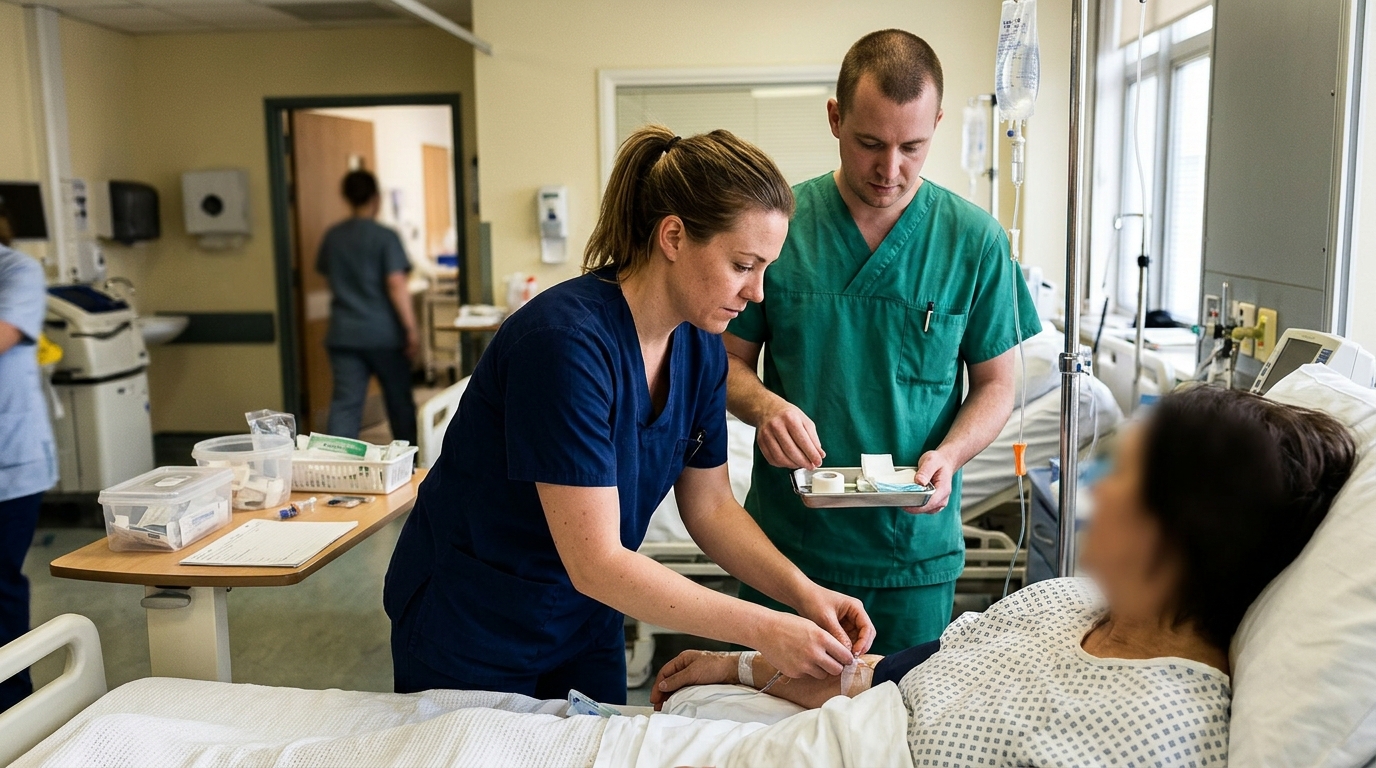
Nursing suits people who can stay organized when several patients need something at once, and who don't mind being on their feet for most of a shift. The work pairs clinical tasks — medications, assessments, wound care, charting — with constant communication between patients, families and physicians, and the U.S. Bureau of Labor Statistics (2025) notes that nurses in hospitals and nursing care facilities often work nights, weekends and holidays.
Becoming a registered nurse in the United States means finishing an approved nursing program, passing the NCLEX-RN and holding a license from your state board of nursing (U.S. Bureau of Labor Statistics, 2025).
What This Career Involves Day to Day
A day shift on a hospital medical-surgical unit opens with handoff report from the outgoing nurse. You take notes on four to six assigned patients: diagnoses, overnight events, pending labs and discharge plans.
You then round with a stethoscope, blood pressure cuff and pulse oximeter — listening to lung and bowel sounds, checking IV sites, documenting each assessment in the electronic health record. For the medication pass you pull doses from the automated dispensing cabinet, scan the patient's wristband and each barcode at the bedside, and program a smart infusion pump for anything running intravenously.
The rest of the shift is interruption-driven: a blood glucose read on a glucometer with insulin adjusted against the sliding-scale order, a sterile dressing change on a post-operative wound, a page to a physician about a blood pressure drifting down, a bed-to-chair transfer with a gait belt and a second staff member. O*NET OnLine lists tasks of this kind — monitoring patient conditions, administering medications and treatments, recording details in patient records — among the representative duties for registered nurses.
Charting fills the gaps and the final hour. The U.S. Bureau of Labor Statistics (2025) describes core RN duties as assessing patient conditions, recording histories and symptoms, administering medicines and treatments, operating and monitoring medical equipment, and teaching patients and families how to manage an illness or injury at home — in practice, explaining a new inhaler to a daughter before you give report to the night nurse.
Signs This Career Might Suit You
- You can hold three unfinished tasks in your head, get interrupted, and still come back and close all three.
- You have stayed steady around blood, vomit, wounds or someone in pain, rather than needing to leave the room.
- You have talked a nervous friend or relative through a medical appointment without talking down to them.
- You prefer standing, moving work, and you have held jobs where you were on your feet for a full shift.
- You double-check details on principle — you reread the dose, the name, the label, even when you are sure.
- Night shifts, weekend work or holiday rotations fit your life rather than wrecking it.
- You speak up when something looks wrong, including to someone more senior than you.
Signs This Career Might Not Be for You
- Standing and walking for most of a shift aggravates existing back, knee or foot problems, and lifting, turning and transferring patients adds repeated strain; the U.S. Bureau of Labor Statistics (2025) notes nurses may be on their feet for most of their shift.
- Rotating nights, weekends and holidays are standard in hospitals and nursing care facilities (U.S. Bureau of Labor Statistics, 2025), so you miss family events and sleep on a schedule that shifts week to week.
- The job carries exposure to infectious diseases and to harmful substances such as drugs and radiation, plus injury risk from moving patients (U.S. Bureau of Labor Statistics, 2025); that exposure does not shrink with experience.
- Patients and families direct fear and anger at whoever is in the room, usually the nurse — expect verbal confrontation during bad news, long waits and restricted visiting.
- Documentation is repetitive and unavoidable: every assessment, medication and refusal goes into the electronic health record, often after the clinical work is finished.
Skills and Traits That Matter Most
| Skill/Trait | Why It Matters on the Job |
|---|---|
| Physical stamina | You are upright through handoff, rounds, medication passes and transfers; a bed-to-chair move with a gait belt takes real strength and two sets of hands. |
| Attention to detail | Scanning a wristband and barcode before each dose only prevents errors if you read the mismatch when the scanner flags it. |
| Organizational skill | With four to six patients, you sequence a dressing change, a glucose check and discharge teaching around scheduled medication times. |
| Critical thinking | A blood pressure drifting down mid-shift has to be interpreted — fluids, medication timing, bleeding — before you page the physician. |
| Communication | Report to the oncoming nurse and teaching a family member wound care at home both fail if you cannot say it plainly. |
| Emotional composure | You absorb anger from a frightened family at one bedside, then walk into the next room needing a neutral face. |
| Comfort with technology | Smart infusion pumps, glucometers, monitors and the electronic health record come up in nearly every hour of the shift. |
Pay, Hours, and Outlook
| What to check | Where the current figure is published |
|---|---|
| Median annual wage for registered nurses | Occupational Outlook Handbook, U.S. Bureau of Labor Statistics (2025) |
| Wage range for the lowest and highest 10 percent | Occupational Outlook Handbook, U.S. Bureau of Labor Statistics (2025) |
| Median wage in hospitals vs. nursing and residential care facilities | Occupational Outlook Handbook, U.S. Bureau of Labor Statistics (2025) |
| Total registered nurse jobs, projected growth 2025–35 and annual openings | Occupational Outlook Handbook, U.S. Bureau of Labor Statistics (2025) |
| State and metro wage estimates | O*NET OnLine, U.S. Department of Labor (2025) |
Pay is almost always an hourly rate with shift differentials for nights, weekends and holidays, plus overtime, and hospital staff roles often add on-call pay. Because rates differ sharply by state, metro area and setting, look up the current median annual wage, the lowest and highest 10 percent range, and the hospital versus nursing and residential care comparison in the BLS Occupational Outlook Handbook, then check state figures on O*NET OnLine.
Most RNs work full time, and those in hospitals and nursing care facilities may work nights, weekends and holidays and may be on call (U.S. Bureau of Labor Statistics, 2025). Twelve-hour shifts are common in hospitals, while clinic, school and occupational health roles are more often weekday daytime work. Hospitals employ the largest share of registered nurses, with the rest across ambulatory care, nursing and residential care facilities, government and schools (U.S. Bureau of Labor Statistics, 2025).
How People Usually Get Started
- Complete prerequisite college courses — typically anatomy and physiology, microbiology and statistics — which most applicants take over one to two semesters before a nursing program will consider them.
- Enroll in an approved nursing program. The U.S. Bureau of Labor Statistics (2025) lists three routes: a bachelor's degree in nursing, an associate's degree in nursing, or a diploma from an approved program. Associate programs are generally two academic years of full-time coursework and clinical rotations; bachelor's programs four. Diploma program length is listed in the Occupational Outlook Handbook and varies by hospital and state.
- Apply for licensure through your state board of nursing and pass the NCLEX-RN. Licensing is required in every state (U.S. Bureau of Labor Statistics, 2025), and application, background check and fee rules are set state by state. Plan on several weeks between graduation and your test date.
- Add the basic certifications employers ask for: CPR and Basic Life Support, and Advanced Cardiovascular Life Support for many hospital units. The U.S. Bureau of Labor Statistics (2025) notes CPR, BLS or ACLS certification may be required for some RN positions.
- Take a new-graduate or nurse residency position, usually on a medical-surgical, telemetry or long-term care unit at a hospital or nursing facility. These run six to twelve months with a preceptor.
- After a year or two at the bedside, pursue specialty certification in areas such as critical care, emergency or oncology from the relevant certifying body. Specialty certification is usually voluntary, though some employers require it (U.S. Bureau of Labor Statistics, 2025).
Frequently asked questions
Do I need a bachelor's degree to become a registered nurse?
No. The U.S. Bureau of Labor Statistics (2025) lists three entry routes: a bachelor's degree in nursing, an associate's degree in nursing, or a diploma from an approved program, and all three lead to the NCLEX-RN and state licensure. Some hospitals prefer or require a bachelor's for certain units and for promotion into management, so read postings where you want to work.
Is nursing physically demanding?
Yes. Nurses may be on their feet for most of their shift, and the work involves lifting, turning and transferring patients, a recognized source of injury (U.S. Bureau of Labor Statistics, 2025). It also carries exposure to infectious diseases and to harmful substances such as drugs and radiation. If you have an existing back or joint problem, talk to a clinician before committing to bedside work.
Will I have to work nights and weekends?
In a hospital or nursing care facility, almost certainly at the start. Those settings run around the clock, so RNs there may work nights, weekends and holidays and may be on call (U.S. Bureau of Labor Statistics, 2025). Clinics, schools and occupational health roles are more often weekday daytime work, but they usually hire nurses who already have hospital experience.
How do I find out what registered nurses earn where I live?
Check the Occupational Outlook Handbook from the U.S. Bureau of Labor Statistics (2025) for the national median annual wage, the range for the lowest and highest 10 percent, and the hospital versus nursing and residential care comparison. Then use O*NET OnLine for state and metro estimates. Posted base rates exclude shift differentials and overtime, which are a real part of hospital nurses' earnings.
Is nursing a better fit than becoming a paramedic?
They reward different temperaments. Paramedic work is episodic and prehospital — short, high-intensity contacts, then handoff — while a registered nurse follows the same patients across a whole shift, manages medication schedules and documentation, and teaches families to manage care at home (U.S. Bureau of Labor Statistics, 2025). If you prefer continuity over rapid turnover, nursing fits better.
Sources
- U.S. Bureau of Labor Statistics — Registered Nurses : Occupational Outlook Handbook (2025)
- O*NET OnLine (U.S. Department of Labor) — 29-1141.00 - Registered Nurses

Written by
Desmond writes about the mechanics of job hunting — resumes, interviews, the strange rituals of being evaluated by strangers. He's drawn to the gap between how hiring is supposed to work and how it actually happens.