How to Become an Electrician: Step-by-Step Guide
Most of this trade is learned on job sites while you draw a paycheck, so the real question is whether four to five years of wiring and code study suits you.
Becoming an electrician usually means getting hired into a paid apprenticeship rather than paying for a degree first. The U.S. Bureau of Labor Statistics (2025) reports that most electricians train through a 4- or 5-year apprenticeship with about 2,000 hours of paid on-the-job training per year plus classroom instruction, and that most states require electricians to pass a test and be licensed.
A high school diploma or equivalent is the typical entry-level education (U.S. Bureau of Labor Statistics, 2025). Hours, exams and renewal rules are set by your state or locality, so the path looks different in Texas than it does in Oregon.
Step-by-Step Path to This Career
- Finish high school or an equivalent credential (up to 4 years; a few months for a GED). A high school diploma or equivalent is listed as the typical entry-level education for electricians (U.S. Bureau of Labor Statistics, 2025). Algebra matters more than you expect, because classroom instruction covers electrical theory and mathematics.
- Check your state licensing board's rules before applying anywhere (1–2 weeks). Apprenticeship and licensing requirements vary by state and locality, and information on state licensing board requirements is available from CareerOneStop (U.S. Bureau of Labor Statistics, 2025). Write down the on-the-job and classroom hours your state counts.
- Optional: complete a pre-apprenticeship or technical school program (a few months to 2 years). The Home Builders Institute offers a pre-apprenticeship certificate training (PACT) program covering eight construction trades, including electricians, for people entering apprenticeships after working as a helper. Technical-school graduates usually receive credit toward their apprenticeship, and military or construction-industry electrical experience may qualify you for a shortened apprenticeship based on experience and testing (U.S. Bureau of Labor Statistics, 2025).
- Get accepted into an apprenticeship (intakes typically run once or twice a year). Unions and contractor associations sponsor apprenticeship programs, and some electrical contractors run their own non-registered training programs (U.S. Bureau of Labor Statistics, 2025). Expect an aptitude test covering algebra and reading comprehension, plus an interview.
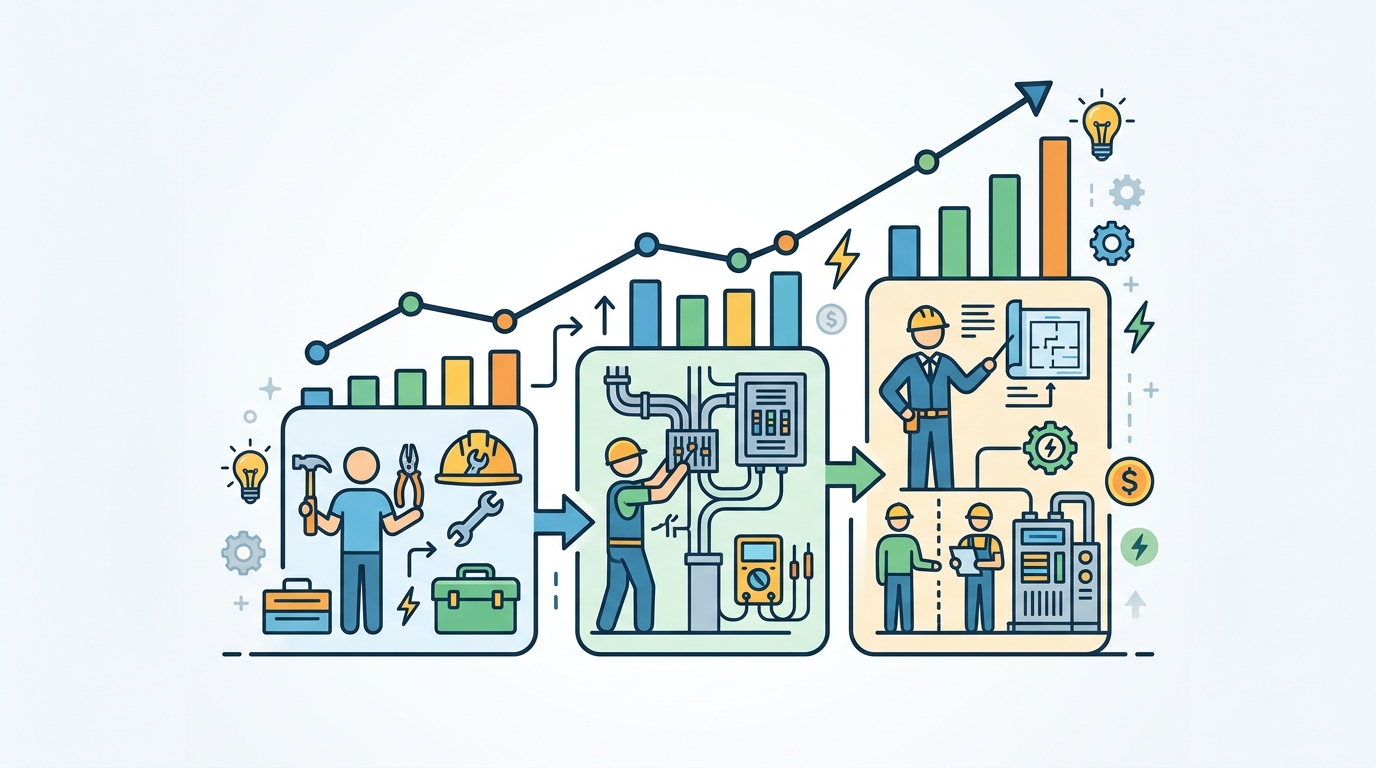
- Work through the apprenticeship (4–5 years). You receive about 2,000 hours of paid on-the-job training per year plus instruction in electrical theory, blueprint reading, mathematics, electrical code requirements, and safety and first-aid practices, with possible specialised training in soldering, communications, fire alarm systems and elevators (U.S. Bureau of Labor Statistics, 2025).
- Pass your state or local licensing exam (study 2–3 months; one sitting). Most states require electricians to pass a test that includes questions on the National Electrical Code and state and local electrical codes (U.S. Bureau of Labor Statistics, 2025). On completing the apprenticeship you are a journey worker and may perform duties on your own, subject to local or state licensing requirements.
- Renew the licence and add certifications (ongoing). Continuing education covering safety practices, code changes and manufacturer product training may be required, and optional certifications cover areas such as solar photovoltaic, electrical generating or lighting systems, with details listed on CareerOneStop (U.S. Bureau of Labor Statistics, 2025). Journey workers who meet additional requirements may become master electricians or move into supervisor or project-management roles.
Education and Training Options Compared
| Path | Time | Typical Cost | Outcome |
|---|---|---|---|
| Registered apprenticeship sponsored by a union or contractor association | 4–5 years, about 2,000 paid on-the-job hours a year plus classroom instruction | No tuition, and you are paid during on-the-job training; out of pocket you buy hand tools, a current National Electrical Code book, boots and PPE | Journey worker status, then eligibility to sit your state or local licensing exam (U.S. Bureau of Labor Statistics, 2025) |
| Technical school program, then an apprenticeship | 1–2 years of school, then a shortened apprenticeship | Tuition charged per credit or per term; ask for the published per-credit rate and total program cost in writing before enrolling | Credit toward apprenticeship hours plus grounding in electrical theory and blueprint reading (U.S. Bureau of Labor Statistics, 2025) |
| Home Builders Institute pre-apprenticeship certificate training (PACT), after helper work | Weeks to months | Confirm fees with the provider delivering PACT in your area | Pre-apprenticeship certificate in one of eight construction trades, used to enter an apprenticeship (U.S. Bureau of Labor Statistics, 2025) |
| Military or construction-industry electrical experience | Shortened apprenticeship based on experience and testing | Cost of the assessment or challenge test, set by the sponsor | Advanced standing rather than starting as a first-year apprentice (U.S. Bureau of Labor Statistics, 2025) |
What You'll Actually Be Doing Once You Start
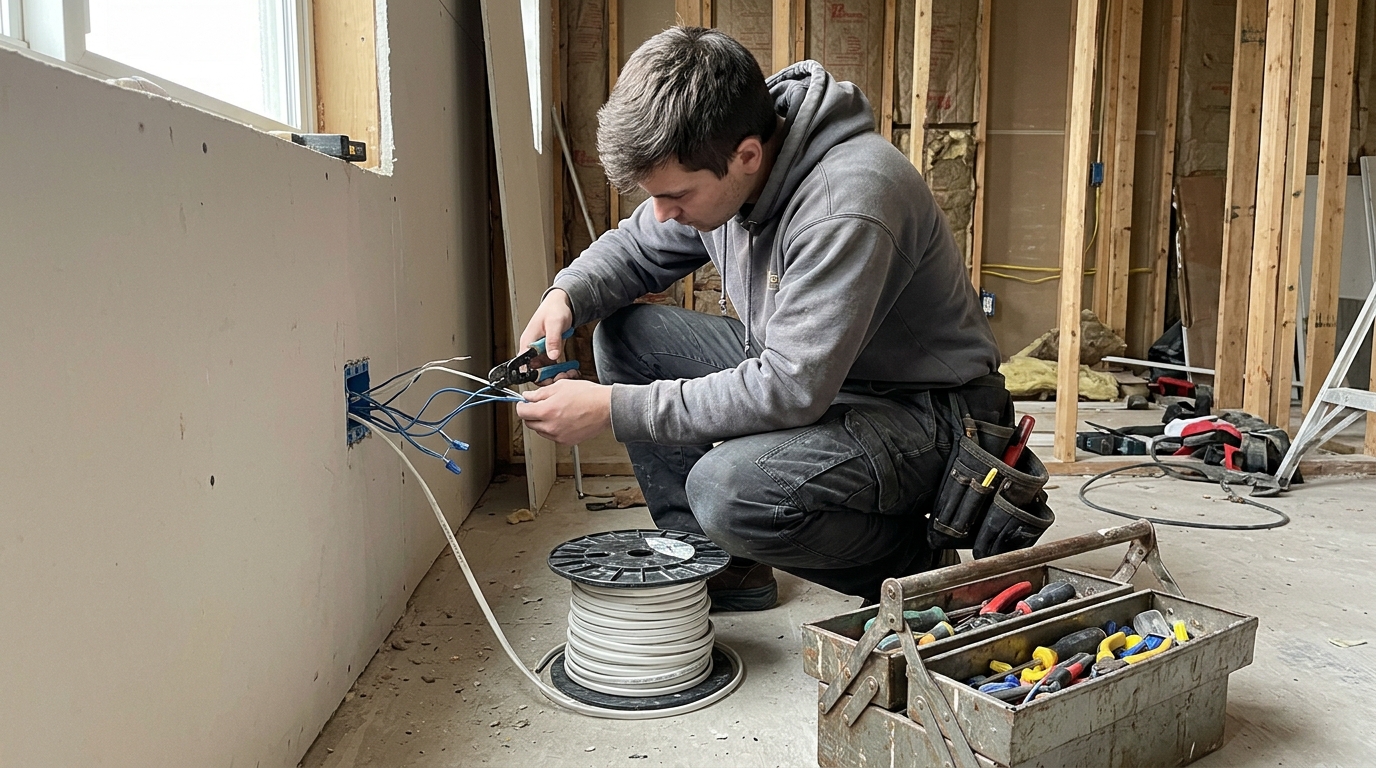
Your first 6 to 12 months look close to the ONET description of Helpers—Electricians (47-3013.00): supplying and holding materials or tools, and cleaning the work area and equipment (ONET OnLine, 2026). In practice that means bending half-inch conduit with a hand conduit bender to a layout someone else marked, pulling wire through finished runs, stripping and terminating conductors with wire strippers, drilling for boxes and hangers with a cordless drill and hole saw, and moving panels and fixtures that may weigh up to 50 pounds (U.S. Bureau of Labor Statistics, 2025).
You also start learning test gear: checking voltage, amperage or resistance with a multimeter, and watching a journey worker use ammeters, voltmeters, thermal scanners and cable testers to find faults (U.S. Bureau of Labor Statistics, 2025). Color vision matters from day one, because wires are identified by color.
The gap between you and senior workers is formal, not just skill. After completing an apprenticeship you are a journey worker and may perform duties on your own, subject to local or state licensing requirements (U.S. Bureau of Labor Statistics, 2025). Journey workers read blueprints and technical diagrams, inspect components such as transformers and circuit breakers, decide how the National Electrical Code applies to a given install, and direct and train other workers — including you.
Almost all electricians work full time, schedules may include evenings and weekends, and overtime is common (U.S. Bureau of Labor Statistics, 2025). Employment was 821,000 in 2025, projected to grow 9 percent from 2025 to 2035 with about 72,700 openings a year on average (U.S. Bureau of Labor Statistics, 2025). Pay is usually hourly, with apprentices on a percentage of the journey-worker rate that steps up as hours accumulate; for current figures, check the Bureau of Labor Statistics Occupational Employment and Wage Statistics median for electricians for May 2025 against local apprenticeship wage schedules.
Costs and Time Investment
| Cost item | Related step | Where to check the current figure |
|---|---|---|
| Technical school tuition | Step 3 (optional school) | Per credit or per term over 1–2 years; request the full program cost from the school's published fee schedule |
| Pre-apprenticeship fees | Step 3 (Home Builders Institute PACT) | Confirm with the local provider delivering the program |
| Apprenticeship application and aptitude test fee | Step 4 (apprenticeship entry) | One-time fee listed in each intake's application packet from the sponsoring union or contractor association |
| Hand and power tools | Step 5 (apprenticeship) | Conduit bender, screwdrivers, wire strippers, drill and saws; many sponsors publish a first-year tool list with prices |
| Testing devices | Step 5 (apprenticeship) | A multimeter at minimum; ammeters and cable testers are often employer-supplied, so ask before buying |
| National Electrical Code book | Steps 5 and 6 | Priced by the publisher; you replace it each code cycle |
| Licensing exam fee | Step 6 (state or local exam) | Set by your licensing board; find yours through CareerOneStop |
| Licence issue and renewal fees | Steps 6 and 7 | Set by the same board on a fixed renewal cycle |
| Continuing education courses | Step 7 (licence maintenance) | Hours per cycle set by your board, covering safety practices, code changes and manufacturer product training |
| Optional certifications | Step 7 (specialisation) | Solar photovoltaic, electrical generating or lighting systems; details listed on CareerOneStop |
The largest investment is time: 4 to 5 years at roughly 2,000 paid on-the-job hours a year, plus evening or weekend classes throughout (U.S. Bureau of Labor Statistics, 2025).
Common Entry Mistakes to Avoid
- Applying to apprenticeships before checking your state board's rules (step 2). Requirements vary by state and locality. Find your board through CareerOneStop, note the required on-the-job and classroom hours, then apply only to programs that document hours in that format.
- Assuming a contractor's non-registered program counts toward licensure (step 4). Some electrical contractors run their own non-registered training programs (U.S. Bureau of Labor Statistics, 2025). Ask the employer in writing whether your state board accepts those hours for exam eligibility before you take the job.
- Booking the licensing exam before your hours are signed off (step 6). Keep a monthly hour log countersigned by your supervising journey worker, and schedule the test only once the sponsor confirms your total.
- Sitting the aptitude test without reviewing algebra (step 4). Spend 4–6 weeks on algebra and reading comprehension practice before the test date, rather than waiting for the next intake, which may be a year away.
- Not claiming credit you already hold (step 3). Military or construction electrical experience can qualify you for a shortened apprenticeship based on experience and testing, and technical-school graduates usually receive credit (U.S. Bureau of Labor Statistics, 2025). Submit transcripts and service records with the application, not after acceptance.
- Studying from an outdated National Electrical Code edition (steps 6 and 7). Confirm which edition your state has adopted before buying the book, and budget for a replacement each cycle.
Frequently asked questions
How long before I can work on my own?
Most electricians train in a 4- or 5-year apprenticeship with about 2,000 hours of paid on-the-job training per year plus classroom instruction (U.S. Bureau of Labor Statistics, 2025). After completing it you are considered a journey worker and may perform duties on your own, subject to local or state licensing requirements. A shortened apprenticeship is possible if you bring military or construction electrical experience and pass the relevant testing.
Does an electrician licence transfer between states?
There is no single national electrician licence. Most states require electricians to pass a test covering the National Electrical Code plus state and local codes, and requirements vary by state and locality (U.S. Bureau of Labor Statistics, 2025). Check both your current and destination state through CareerOneStop before moving, and ask each board what hours and credentials it accepts from elsewhere.
Do I need a college degree first?
No. A high school diploma or equivalent is the typical entry-level education for electricians (U.S. Bureau of Labor Statistics, 2025). Some people attend a technical school first, and graduates usually receive credit toward their apprenticeship, which can shorten the 4- to 5-year training period.
What are the physical demands?
The work calls for physical stamina and the strength to move components that may weigh up to 50 pounds, and color vision is needed to identify wires by color (U.S. Bureau of Labor Statistics, 2025). Expect long stretches kneeling, working overhead and bending conduit on site. If color vision is a concern, have it checked before you apply to an apprenticeship.
Sources
- U.S. Bureau of Labor Statistics — Electricians : Occupational Outlook Handbook (2025)
- U.S. Bureau of Labor Statistics — Electricians : Occupational Outlook Handbook (2025)

Written by
Mireille thinks about work the way some people think about weather: always shifting, worth tracking closely. She edits pieces on hiring trends and the small negotiations that shape a career, and has little patience for advice that assumes everyone wants the same thing from a job.