Accountant vs Bookkeeper: Which Career Is Right for You?
Both roles handle the same ledgers from different ends: one records transactions, the other interprets them, and the training gap between them is years long.
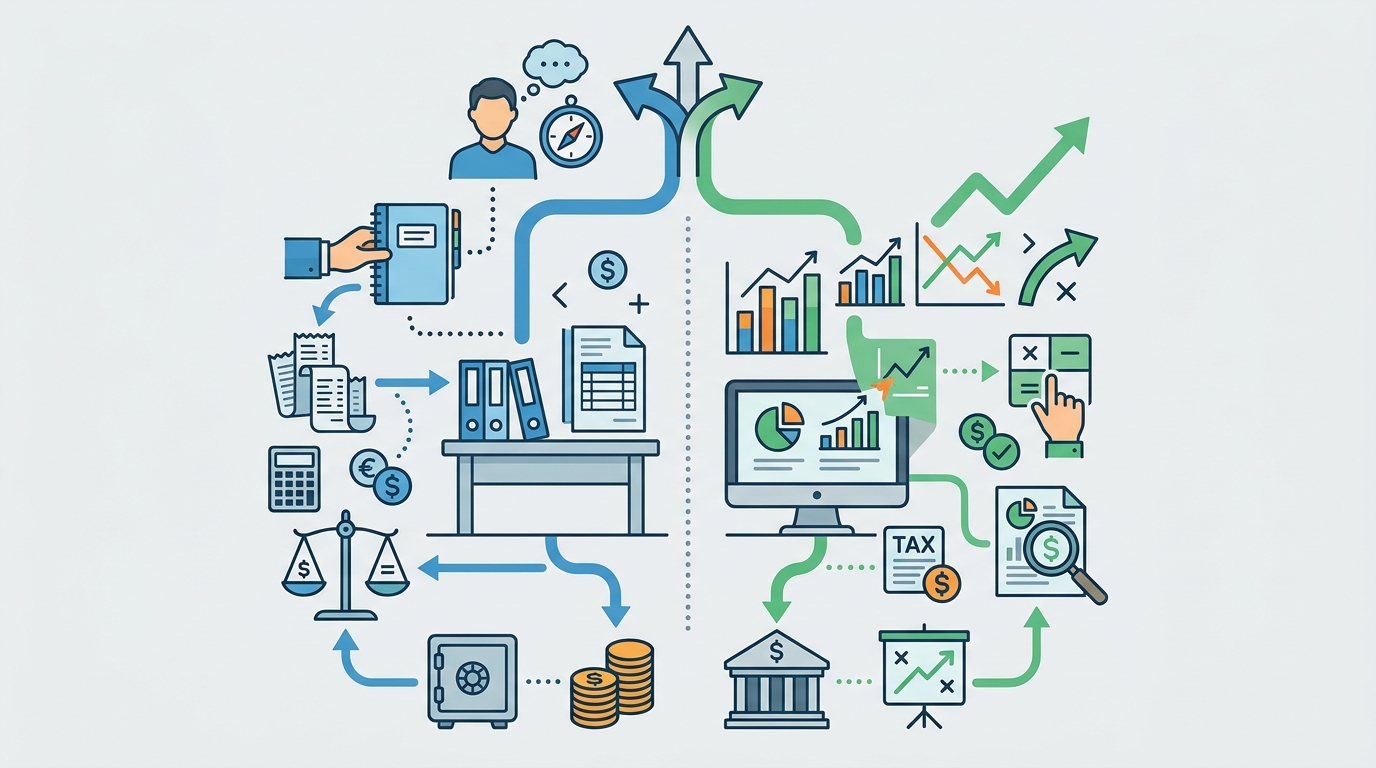
Accountants and bookkeepers both work inside a company's financial records, but they enter at different points. Bookkeeping, accounting, and auditing clerks post the transactions, reconcile the bank accounts, and produce routine reports; accountants and auditors examine those records for accuracy and legal compliance, compute taxes owed, and suggest ways to reduce costs and improve profits (U.S. Bureau of Labor Statistics, 2025). The pay difference is substantial — a median of $83,680 a year for accountants and auditors against $50,670 for bookkeeping, accounting, and auditing clerks in May 2025 (U.S. Bureau of Labor Statistics, 2025) — and so is the schooling behind it.
The decision usually comes down to how much college you are willing to finish, whether you want to work alone or on a team, and whether you prefer closing a clean set of books or interpreting what the books mean.
Side-by-Side Comparison
The two occupations are tracked separately by the U.S. Bureau of Labor Statistics, and the figures below come from its May 2025 wage data and its 2025–2035 projections.
| Dimension | Accountant / Auditor | Bookkeeping, Accounting & Auditing Clerk |
|---|---|---|
| Median annual pay | $83,680, or $40.23 an hour, May 2025 (U.S. Bureau of Labor Statistics, 2025) | $50,670, or $24.36 an hour, May 2025 (U.S. Bureau of Labor Statistics, 2025) |
| Typical entry-level education | Bachelor's degree (U.S. Bureau of Labor Statistics, 2025) | Some college, no degree (U.S. Bureau of Labor Statistics, 2025) |
| Licensing | CPA licence issued by a state Board of Accountancy, required for any accountant filing a report with the SEC, with 150 semester hours of coursework in all states (U.S. Bureau of Labor Statistics, 2025) | No licence usually required; optional AIPB Certified Bookkeeper (CB) or NACPB Certified Public Bookkeeper (CPB) (U.S. Bureau of Labor Statistics, 2025) |
| Typical schedule | Full time, with longer hours during quarterly audits and tax season (U.S. Bureau of Labor Statistics, 2025) | Full time, with extra hours at the end of the fiscal year, at tax time, and during accounting audits (U.S. Bureau of Labor Statistics, 2025) |
| Job growth, 2025–2035 | Up 5 percent, about 115,300 openings a year (U.S. Bureau of Labor Statistics, 2025) | Down 6 percent, about 144,100 openings a year, all from replacing workers who leave the occupation (U.S. Bureau of Labor Statistics, 2025) |
| Typical work setting | Offices, some work from home, usually in teams though some work alone, with travel to clients' places of business (U.S. Bureau of Labor Statistics, 2025) | Office setting, often working alone; bookkeepers serving several firms visit clients' places of business (U.S. Bureau of Labor Statistics, 2025) |
| Physical demands | Seated desk work at a monitor, with extended hours at the screen through quarterly audits and tax season, plus driving or flying to client sites (U.S. Bureau of Labor Statistics, 2025) | Seated desk work with sustained keyboard and 10-key entry, plus handling and filing incoming cash, checks, and vouchers (U.S. Bureau of Labor Statistics, 2025) |
| Core tools | Spreadsheets, general ledger and ERP systems, tax preparation software, audit workpaper files | Bookkeeping software such as QuickBooks Online, spreadsheets, scanners, deposit and voucher records (U.S. Bureau of Labor Statistics, 2025) |
| Advancement titles | Cost Accountant, Internal Auditor, Financial Reporting Accountant, Audit Partner (O*NET OnLine) | Accounting Specialist, Accounting Technician, Accounts Payable Clerk, and accountant or auditor with added education and experience (O*NET OnLine; U.S. Bureau of Labor Statistics, 2025) |
A Day in Each Role
An accountant's morning often starts inside a client's general ledger, examining financial statements for accuracy and legal compliance before a filing deadline. By mid-morning you might be computing taxes owed and drafting a return in tax preparation software, then opening a workpaper file to document how you tested a revenue account. Afternoons go to inspecting account books and accounting systems for weaknesses, a video call with two colleagues on the engagement team, and a short memo suggesting two ways the client could cut costs and improve profits. During a quarterly audit you may spend the day at the client's place of business rather than your own office, and longer hours are typical during quarterly audits and tax season (U.S. Bureau of Labor Statistics, 2025).
A bookkeeper's day runs on the transaction cycle. You open QuickBooks Online or a comparable package and post the previous day's financial transactions, then receive and record the cash, checks, and vouchers that arrived in the mail. Mid-morning might be an accounts payable run and a bank reconciliation, where you check figures against the statement and trace a mismatched line until the two sides agree. Later you produce reports — a balance sheet and an income statement for the owner — and code receipts against the chart of accounts. Much of this is done alone at one desk, though if you serve several small firms you may drive between client offices (U.S. Bureau of Labor Statistics, 2025).
Choose Accountant If...
- You are prepared to finish a bachelor's degree, and possibly the 150 semester hours required for CPA licensure through your state Board of Accountancy — 30 hours more than a usual four-year bachelor's degree (U.S. Bureau of Labor Statistics, 2025).
- You want the higher median: $83,680 a year against $50,670 for bookkeeping, accounting, and auditing clerks, May 2025 (U.S. Bureau of Labor Statistics, 2025).
- You accept longer hours during quarterly audits and tax season in exchange for quieter months afterward (U.S. Bureau of Labor Statistics, 2025).
- You would rather work in a team and travel to clients' places of business than sit at the same desk every day (U.S. Bureau of Labor Statistics, 2025).
- You like judgment calls — deciding whether a financial statement complies with the law, or arguing for a change that cuts a client's costs — more than getting a ledger to balance.
Choose Bookkeeper If...
- You want to start earning without a bachelor's degree; typical entry-level education is some college, no degree (U.S. Bureau of Labor Statistics, 2025).
- You prefer working alone in an office for most of the day rather than inside an audit team (U.S. Bureau of Labor Statistics, 2025).
- You find satisfaction in closing out a reconciliation — tracing a mismatched figure through the bank statement until the accounts agree — rather than interpreting what the numbers imply.
- You want certification to be optional rather than mandatory: the AIPB Certified Bookkeeper and NACPB Certified Public Bookkeeper credentials are chosen, not required (U.S. Bureau of Labor Statistics, 2025).
- You intend to use the job as a route rather than a destination; with appropriate experience and additional education, some bookkeeping, accounting, and auditing clerks become accountants or auditors (U.S. Bureau of Labor Statistics, 2025).
Getting Started in Either Path
| Step | Accountant / Auditor | Bookkeeping, Accounting & Auditing Clerk |
|---|---|---|
| Typical entry credential | Bachelor's degree in accounting; CPA licence from a state Board of Accountancy after 150 semester hours, with most jurisdictions allowing you to sit the CPA Exam at 120 semester hours (U.S. Bureau of Labor Statistics, 2025; 300Hours, 2026) | College coursework in accounting, with the optional NACPB Certified Public Bookkeeper licence — four exams in Accounting Fundamentals, Payroll Fundamentals, QuickBooks Online, and Bookkeeping (PracticeTestGeeks, 2026) |
| Typical time to entry | A usual four-year bachelor's degree, then a further 30 semester hours of coursework to reach the 150 semester hours every state requires for CPA licensure (U.S. Bureau of Labor Statistics, 2025) | The NACPB Certified Public Bookkeeper licence requires no prior work experience, only NACPB's own education courses and four exams; the AIPB Certified Bookkeeper credential requires a four-part exam plus two years of full-time experience or 3,000 part-time hours (PracticeTestGeeks, 2026; Forbes Advisor) |
| First job title | General Accountant, Cost Accountant, Internal Auditor, or Accounting Officer (O*NET OnLine) | Accounting Clerk, Accounts Payable Clerk, Accounts Receivable Clerk, or Accounting Assistant (O*NET OnLine / CareerOneStop) |
If you are unsure, the bookkeeping route is the cheaper experiment. An Accounting Clerk post gets you inside a general ledger without a completed degree, and the coursework you take toward an NACPB licence overlaps with the early accounting curriculum. Check current wages for both occupations in your state on the Bureau of Labor Statistics occupational wage pages, and confirm education and examination rules with your own state Board of Accountancy before you enrol anywhere — CPA requirements are set state by state.
Frequently asked questions
Which pays more, an accountant or a bookkeeper?
Accountants and auditors had a median annual wage of $83,680 in May 2025, while bookkeeping, accounting, and auditing clerks had a median of $50,670 (U.S. Bureau of Labor Statistics, 2025). The gap reflects the bachelor's degree typically expected of accountants and auditors against the some-college entry point for bookkeeping, accounting, and auditing clerks. Pay for both varies by state, industry, and employer size, so check the current figures for your own area before committing.
Is one career more secure than the other?
The projections point in opposite directions: employment of accountants and auditors is projected to grow 5 percent from 2025 to 2035, while employment of bookkeeping, accounting, and auditing clerks is projected to decline 6 percent over the same period (U.S. Bureau of Labor Statistics, 2025). Bookkeeping, accounting, and auditing clerks still see about 144,100 openings a year, but all of them come from the need to replace workers who leave the occupation, against about 115,300 a year for accountants and auditors. No one can promise you a job in either occupation, but accounting and auditing is the path adding positions rather than shedding them.
Can I move from bookkeeper to accountant later?
Yes — with appropriate experience and additional education, some bookkeeping, accounting, and auditing clerks become accountants or auditors (U.S. Bureau of Labor Statistics, 2025). The usual obstacle is the degree: accountant and auditor roles typically expect a bachelor's, and CPA licensure requires 150 semester hours of college coursework in every state. Working as an Accounting Clerk while studying part-time is a common way to cover both, since the ledger work overlaps directly with the accounting curriculum.
Which role is more stressful day to day?
The stress is shaped differently. Accountants and auditors absorb concentrated pressure around quarterly audits and tax season, when longer hours are typical and a filing has legal consequences if the numbers are wrong (U.S. Bureau of Labor Statistics, 2025). Bookkeeping, accounting, and auditing clerks work to a steadier rhythm with spikes at fiscal year end, tax time, and during audits, but spend more of the day alone at a desk doing sustained keyboard and 10-key entry (U.S. Bureau of Labor Statistics, 2025).
Sources
- U.S. Bureau of Labor Statistics — Accountants and Auditors : Occupational Outlook Handbook (2025)
- U.S. Bureau of Labor Statistics — Bookkeeping, Accounting, and Auditing Clerks : Occupational Outlook Handbook (2025)
Written by
Mireille thinks about work the way some people think about weather: always shifting, worth tracking closely. She edits pieces on hiring trends and the small negotiations that shape a career, and has little patience for advice that assumes everyone wants the same thing from a job.