Nursing Interview Questions and How to Answer Them
From panel questions about a deteriorating patient to proving you can chart cleanly in Epic, here is what nurse managers actually probe for.
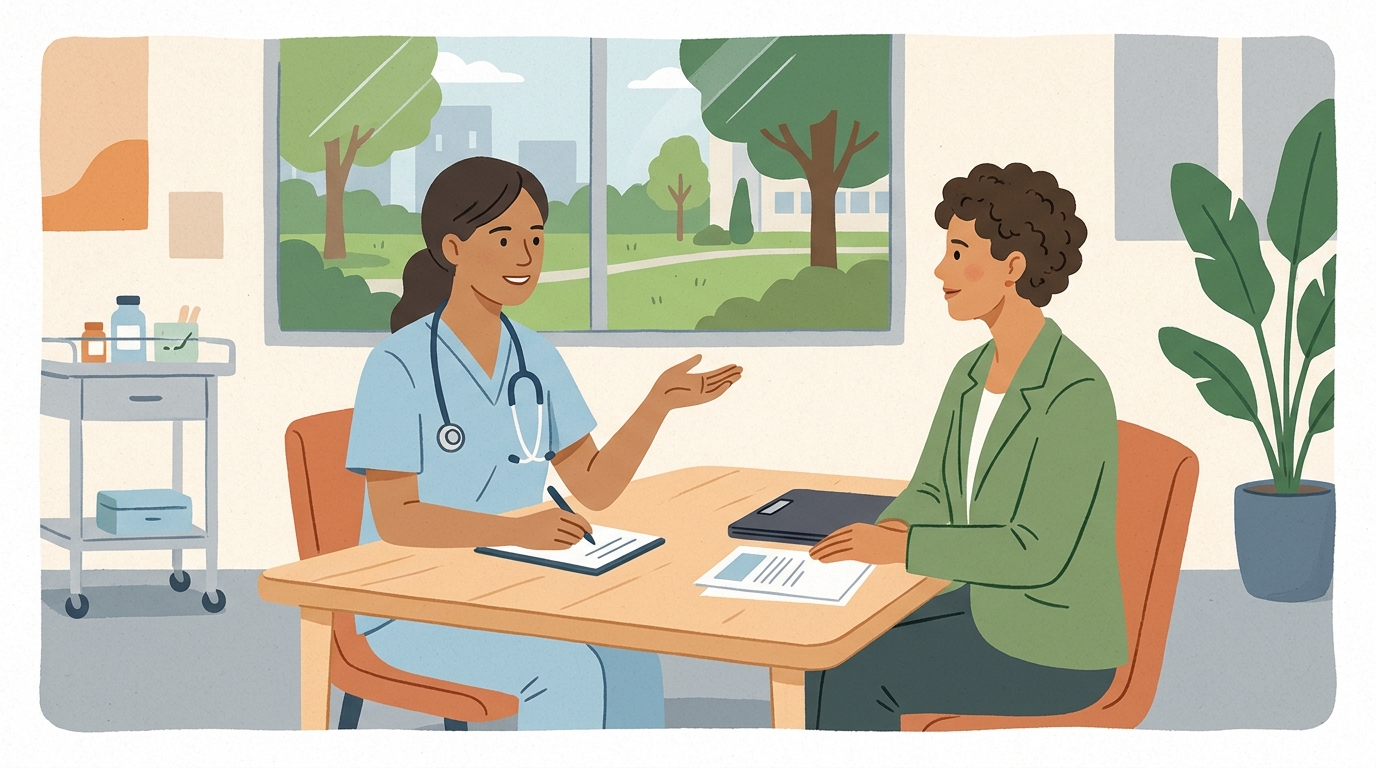
Nursing interviews test clinical judgment and communication at the same time. Expect scenario questions about a deteriorating patient, behavioral questions about conflict with physicians or families, and practical questions about shift availability, charting and your certifications — usually across two to four rounds with a nurse recruiter, the nurse manager and a peer panel.
Below are the questions as interviewers phrase them out loud, sample answers built on real clinical detail, and a script for the hardest one: the error you made.
What to Expect From a Nursing Interview
For a staff nurse post, expect two to four rounds. A nurse recruiter usually runs the first screen by phone, covering your license status, the units you have worked, your availability for nights, weekends, holidays and on-call, and whether your certifications are current. Nurses in hospitals and nursing care facilities usually work shifts to provide round-the-clock coverage (U.S. Bureau of Labor Statistics, 2026), so availability is a screening question, not small talk.
The second round is with the nurse manager or unit director who owns the schedule. This is where scenario questions appear: a patient's blood pressure drops, a telemetry alarm fires, two admissions arrive at once.
Many employers add a peer panel of charge nurses, preceptors and staff nurses from the unit, who grade you on teamwork, delegation and how you escalate. Some add a skills checklist, a dosage calculation test, or a shadow shift on the floor.
What makes it distinct from a generic interview: almost every answer has to end in patient safety. Interviewers listen for the chain of command, for closed-loop communication, and for whether you document what you did. Hospitals — state, local and private — are the largest employer category for registered nurses (U.S. Bureau of Labor Statistics, 2025), and their hiring processes tend to be the most structured.
Common Nursing Interview Questions and Sample Answers
"Tell me about yourself and why you want to work on this unit."
"I have three years on a 32-bed medical-surgical floor with telemetry overflow, so my typical assignment is five patients with drips, drains and post-op day one care. I precept new graduates and sit on the falls committee. I want this unit because it is dedicated cardiac step-down and I would use my ACLS more than twice a year. I also looked at your shared governance council — I want a unit where staff nurses set practice standards rather than hear about them."
"Walk me through what you'd do if a patient's condition suddenly deteriorated on your shift."
"I start at the bedside, not the monitor: airway, breathing, circulation, a full set of vitals, level of consciousness, and a glucose if the mentation changed. If the early warning score climbs, I call rapid response and have a colleague bring the crash cart. Then I give SBAR — 'Mrs. R in 412, post-op day two bowel resection, heart rate 128, systolic 82, mottled knees; I need you now and I think she's septic.' I pull the sepsis order set, draw lactate and cultures before antibiotics, and document times as I go."
"Tell me about a time you disagreed with a physician about a patient's care. What did you do?"
"Situation: a resident ordered a 1,000 mL bolus for a hypotensive patient with known heart failure and crackles to the mid-lung fields. Task: support the pressure without tipping her into pulmonary edema. Action: I called him with SBAR, gave her weight trend and oxygen requirement, and asked for smaller aliquots with reassessment; when the order stood, I used the chain of command and paged the attending, documenting both calls. Result: the order changed to 250 mL increments, her saturation stayed above 94 percent, and she avoided BiPAP."
"How do you prioritize when four patients need you at once?"
"I sort by what kills first. Airway, breathing and circulation come before comfort and paperwork. Concretely: new shortness of breath, then the time-critical antibiotic inside its window, then post-op pain medication, then discharge teaching. I delegate what is in scope — vitals, a blood sugar, a bed change — to the CNA with a specific time to report back, and I give the waiting patient a real number: 'I'll be back in fifteen minutes.' Then I tell the charge nurse I'm stacked."
"Walk me through the steps you take before giving a high-alert medication like insulin or heparin."
"Two identifiers, barcode scan of patient and medication, and the five rights read against the MAR in Epic. For insulin I verify the point-of-care glucose, the sliding scale and whether the tray has arrived. For heparin I check the most recent aPTT or anti-Xa and the weight the pump dose was built on. Both get an independent double check with a second RN who looks at the pump screen, not at me. If the dose looks off against protocol, I hold and call pharmacy."
"How do you handle a family member who is angry about their relative's care?"
"Situation: a daughter blocked the doorway shouting that her father had waited two hours for pain medication. Task: de-escalate and fix the actual gap. Action: I moved us to the quiet room, sat down, let her finish without defending, then summarized back what I had heard. Checking the MAR, I found the order written as PRN every six hours when he needed scheduled dosing, and called the hospitalist. Result: he was switched to a scheduled regimen, I rounded on his pain hourly, and she asked for me the next shift."
"What electronic health record systems have you used, and how do you keep your charting accurate?"
"I have charted in Epic and, in a previous role, MEDITECH — both are listed among the medical software used by registered nurses (O*NET OnLine, 2026). I chart in real time at the bedside workstation, because notes reconstructed at 0700 are where errors creep in. Assessments go in by the unit's timing standard, intake and output every shift, and anything I escalate gets a note with the time, who I spoke to and their response. I never copy forward an assessment I did not perform."
"How do you handle working nights, weekends, and holidays?"
"I have worked a rotating pattern for two years, so I know what my body needs: blackout curtains, a fixed sleep block, and no day shift the morning after three nights. Nurses in hospitals usually work shifts for round-the-clock coverage (U.S. Bureau of Labor Statistics, 2026), so I would rather name what I can sustain than leave in six months. I can commit to nights with every third weekend and your holiday rotation. I would want to know how self-scheduling and floating work here."
"What questions do you have for us?"
Ask what only this unit can answer:
- What is the nurse-to-patient ratio on days versus nights, and what happens to it when someone calls out?
- How long is orientation for an experienced hire, and who assigns preceptors?
- How often do nurses here get floated, and to which units?
- What has the unit practice council changed in the last year?
- What does the charge nurse pathway look like for someone aiming at a charge role or CNOR?
How to Answer the Hardest Question You'll Face
The hardest question in a nursing interview is some version of: "Tell me about a mistake you made that reached a patient." Deflecting reads as unsafe, because a nurse who has never caught an error is usually a nurse who has never looked. Answer with the error, the disclosure, and the system change.
Sample answer
"Early in my second year I gave a scheduled metoprolol to a patient whose heart rate had dropped into the fifties. The barcode scanned and the five rights checked out, but I charted the vitals the CNA handed me without reading them first. About forty minutes later he was symptomatically bradycardic, dizzy on standing.
I stayed with him, got him back in bed, repeated vitals, and called the hospitalist with SBAR, saying plainly what I had given and when. We held the next two doses, he was monitored on telemetry overnight, and there was no lasting harm. I filed the safety event report myself and told him and his wife what had happened.
What changed is that I now read the vital signs myself, on the monitor or in Epic, before any rate-control or blood pressure medication — never off a sheet of paper. I raised it at a staff meeting and we added a parameter reminder to the beta blocker administration workflow. I was embarrassed. I would rather be the nurse who reports it the same hour than the one who hopes nobody notices."
Frequently asked questions
When should I bring up pay, shift differentials and sign-on terms?
Let the nurse recruiter raise it in the first screen, then get the whole picture before you counter: base rate, night and weekend differentials, charge pay, certification pay and on-call. Ask for the written offer first. For current rates, check the U.S. Bureau of Labor Statistics wage data for registered nurses, plus your state board and any union contract covering the unit.
What do I say if a panel asks a clinical question I can't answer?
Say what you would do to find out, and name the resource: the unit protocol, pharmacy, the policy library, the charge nurse. "I don't know that drug's compatibility off the top of my head — I'd check the IV compatibility reference and call pharmacy before running it with the existing line" is a safe answer. Guessing at a dose is the version that fails.
How do I follow up after the interview?
Email the nurse manager within 24 hours, referencing one specific thing from the conversation — the ratio, the orientation length, the unit council. If you met a peer panel, ask the recruiter to pass on your thanks rather than hunting down staff nurses' addresses. If the date the recruiter gave passes, one check-in is reasonable; credentialing and background checks often add weeks.
I'm a new graduate. How is my interview different?
You will be asked about clinical rotations rather than assignments, so prepare two or three patient stories from your capstone or preceptorship in the same structure an experienced nurse would use. Expect questions on licensure timing — nurses must graduate from an approved program and pass a qualifying exam, with requirements such as background checks varying by state (U.S. Bureau of Labor Statistics, 2026). Ask about residency: Registered Nurse Resident is among the apprenticeship titles vetted by the Department of Labor (O*NET OnLine, 2026).
Will they ask about my licensing exam or education path?
Often, briefly. Registered nurses usually take one of three paths — a bachelor's degree, an associate's degree, or a diploma from an approved program — and must be licensed (U.S. Bureau of Labor Statistics, 2026). State your path, your license status and any endorsement in progress. The licensing examination is developed through the National Council of State Boards of Nursing, whose member boards act together on licensure matters.
Sources
- U.S. Bureau of Labor Statistics — Registered Nurses : Occupational Outlook Handbook (2025)
- O*NET OnLine (U.S. Department of Labor) — 29-1141.00 - Registered Nurses — Software Skills (2026)

Written by
Priya turns job-market numbers into something readable, chasing the story behind a wage chart or an unemployment figure. She's most interested in what statistics miss about an actual day at work.