How to Prepare for a Flight Attendant Interview
From the group discussion round to the in-flight scenario questions, here is what airline recruiters look at and how to rehearse before you walk in.
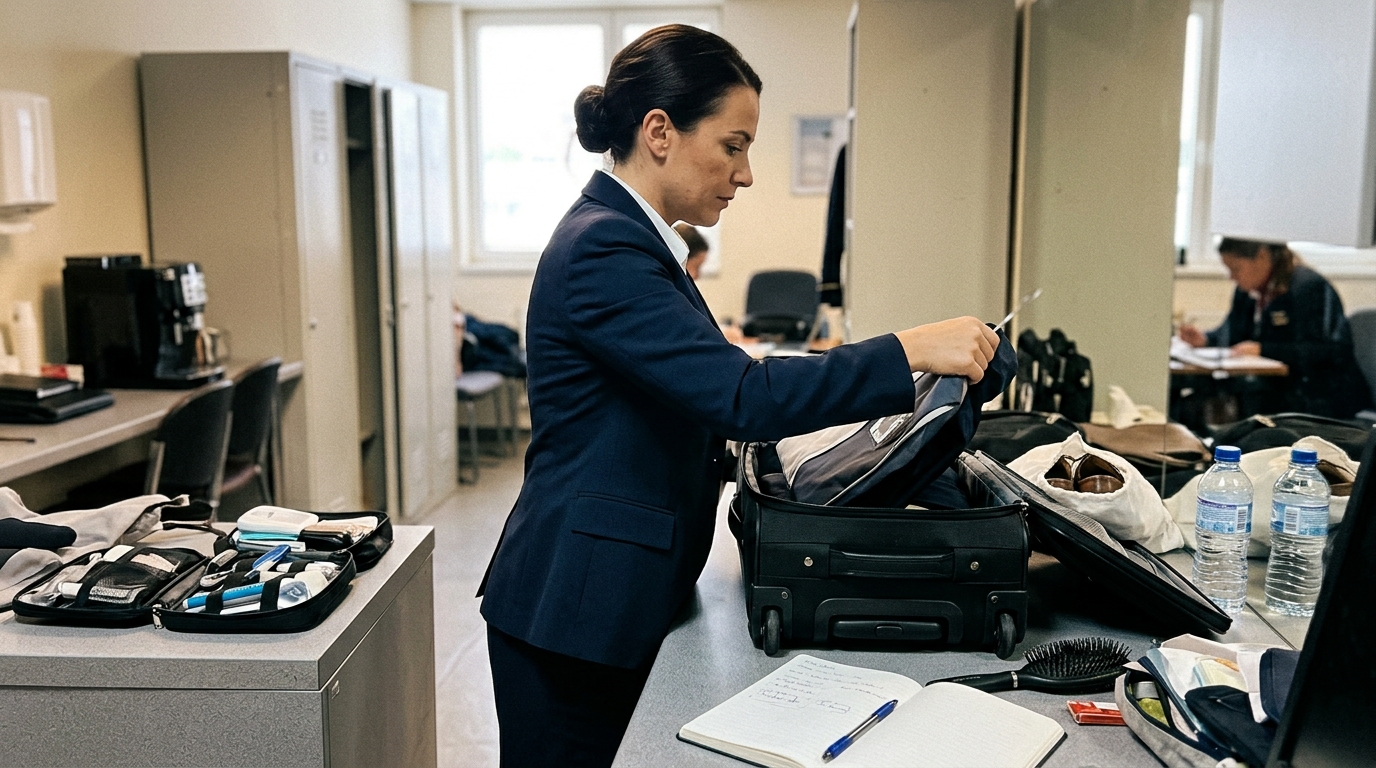
A flight attendant interview is less about your résumé than about watching how you behave in a room. Airlines screen for service instinct, calm decision-making and the ability to work with strangers, so most hiring processes include a group stage alongside a one-to-one conversation — one description of the process says it generally consists of at least three parts, typically beginning with a group discussion round (CareerRoo).
Prepare by doing three things: collecting real service stories you can tell in 90 seconds, rehearsing a cabin announcement out loud, and confirming your eligibility documents are current before the day.
Step-by-Step Interview Preparation Plan
- Map the airline's stages on one page. Write down each round you are told about and who runs it: a recruiter or talent team member for the phone screen and any one-way video interview, a recruiting panel or crew-member assessors for the group discussion and role-plays, and a recruiter or base/inflight leader for the final one-to-one. One airline's process was reported as an online application and assessment, then a one-way video interview, then an in-person interview or open-house event with a presentation followed by small-group interviews involving in-flight scenario questions and a practical exercise such as delivering an announcement (NoraHQ Interview Guides). Processes differ by airline, so treat your invitation email as the authority and ask the recruiter what each round involves.
- Build a service-experience inventory. List every job where you handled the public and, beside each, two specific incidents: an angry customer, a mistake you fixed, a rush you worked through. Flight attendants typically need one or two years of work experience in a service occupation, such as customer service positions in restaurants, hotels or resorts, before getting their first job (U.S. Bureau of Labor Statistics, 2025), so your examples should come from that kind of setting.
- Confirm your eligibility paperwork. Produce a short checklist with dates: your passport expiry, the airline's minimum age (typically 18 or 21), eligibility to work in the United States, and consent for a background check and drug test (U.S. Bureau of Labor Statistics, 2025). Note the airline's published requirements on vision correctable to at least 20/40, any height requirement it sets, and any medical evaluation (U.S. Bureau of Labor Statistics, 2025). Chase anything that needs renewing now, not the week of the interview.
- Draft and rehearse six STAR answers. Keep the four parts distinguishable when you speak.
"Tell me about a time you had to calm an upset customer."
I was the closing front desk agent at a 180-room airport hotel the night a storm cancelled the late bank of flights. My task was to place about forty walk-in guests with only eleven rooms left and no manager on site. I called our three overflow properties, built a waiting list on the property management system so nobody lost their place, handed out water and told each group a real time for their shuttle rather than "soon." Every guest was placed by 2am, we had no chargebacks the next day, and two of them named me in the post-stay survey comments.
- Rehearse a cabin announcement out loud. Write a 45-second boarding or arrival announcement, read it into your phone, and listen for rushed openings, dropped word endings and a flat sign-off. If the airline operates international routes, note any language you can offer — those working on international flights may need fluency in a foreign language (U.S. Bureau of Labor Statistics, 2025) — and record a short version in that language too.
- Plan how you will behave in the group round. One airline's assessment day was reported to involve group exercises and role-plays evaluating teamwork, communication and collaboration (NoraHQ Interview Guides). Decide in advance on three moves: bring in the quietest person by name, summarise the group's position once, and agree with someone else's idea out loud before adding to it. Practise with friends on a topic such as "what should a crew do when a flight is delayed three hours at the gate."
- Prepare your appearance to the airline's stated standard. Flight attendants should present a professional appearance, which may be defined by the employer (U.S. Bureau of Labor Statistics, 2025). Read the airline's grooming or appearance guidance, then try the full outfit on — jacket, shoes, hair up if required — and walk in it for twenty minutes.
- Write your own questions and your logistics. Pick five questions from the list below, write them on one card, and confirm the venue, start time and parking or transit route the day you receive the invitation.
Day-Before and Day-Of Checklist
- Valid passport plus a government photo ID, in a folder you can hand over without unpacking a bag.
- Four printed copies of your résumé on one page, listing your service roles with dates.
- A typed reference list with current phone numbers and job titles for two service managers.
- Any certificates you hold — first aid, CPR, food handling, language qualifications — printed and in the same folder.
- Your full interview outfit laid out the night before, shoes included, checked against the airline's appearance guidance.
- An index card with your 45-second announcement script and the five questions you plan to ask.
- The invitation email printed or screenshotted, with the recruiter's name and the room or venue details.
- A route plan that gets you to the venue 30 minutes before the posted start time, with a backup train or parking option written down.
- Water and a small snack, since open-house and assessment days for cabin crew can run several hours without a scheduled break.
- Phone charged to full with a power bank, plus the recruiter's contact number saved in case of travel delay.
- For a one-way video interview: a tested webcam and microphone, a plain background, a lamp facing you, and one practice recording watched back.
- A pen and notepad for the in-flight scenario questions, so you can write down multi-part scenarios before answering.
Questions to Ask Your Interviewer
- How long does your initial training programme run, and how much of it is emergency procedures versus service? Initial training typically lasts several weeks or a few months at the airline's flight training centre (U.S. Bureau of Labor Statistics, 2025).
- What do the practice flights at the end of training look like, and how are trainees assessed on them?
- Which aircraft type would I be certified on first, and how soon would I be scheduled for additional type training? Flight attendants are certified for specific aircraft types and must take new training for each type (U.S. Bureau of Labor Statistics, 2025).
- How is recurrent training scheduled each year, and is it paid and rostered or taken on days off?
- Which bases currently have openings for new hires, and how long do new attendants typically sit on reserve before holding a line?
- How is advancement handled here — on international flights, senior attendants frequently oversee the work of other attendants (U.S. Bureau of Labor Statistics, 2025), so what does the path to purser or lead look like?
- Is there a language qualification or premium for international routes, and how do you test it?
- How is pay structured — flight hours, per diem, boarding pay — and where can I read the current rates for this base?
- What does a crew do here when a passenger needs first aid in flight, and how are those events debriefed afterwards?
- What happens between a job offer and a training class start date, and what does the background check and drug test timeline look like (U.S. Bureau of Labor Statistics, 2025)?
Frequently asked questions
How early should I arrive for a cabin crew open house or assessment day?
Plan to reach the venue 30 minutes before the posted start, then walk in about 15 minutes early. Assessors and recruiting staff often watch the waiting area, so treat it as part of the day: greet people, stay off your phone, and learn two or three candidates' names. Build a backup route into your plan, because arriving late to a group round usually means missing the exercise entirely.
What should I wear to a flight attendant interview?
Dress as if you were reporting for duty in uniform: a suit or tailored dress, closed, polished shoes you can stand in for hours, hair tidy and off the collar. Flight attendants should present a professional appearance, which may be defined by the employer (U.S. Bureau of Labor Statistics, 2025), so read the airline's published grooming guidance and follow it, including any guidance on visible tattoos, jewellery and nails.
How many rounds should I expect, and how long do they take?
It varies by airline. One description says a flight attendant interview process generally consists of at least three parts, typically beginning with a group discussion round (CareerRoo), and another describes multiple stages with each airline taking a slightly different approach (Eton College). For one airline, the final interview was reported as 45 to 60 minutes focused on behavioural evaluation and fit (NoraHQ Interview Guides). Ask your recruiter for that airline's schedule.
How do I handle a one-way video interview?
Record one practice answer first and watch it back for volume, eye line and background clutter. Keep answers to 60 to 90 seconds with a clear result at the end, look at the lens rather than your own image, and have your announcement card just off camera. Dress for it exactly as you would for the in-person round, since the same recruiting team reviews both.
What happens after the interview if I am hired?
Airlines provide initial training at their flight training centre, typically lasting several weeks or a few months, covering evacuations, emergency equipment, first aid, flight regulations and company operations (U.S. Bureau of Labor Statistics, 2025). You must complete it to keep the job, and all flight attendants must be certified by the FAA, receiving the Certificate of Demonstrated Proficiency once initial training is passed (U.S. Bureau of Labor Statistics, 2025).
Sources
- U.S. Bureau of Labor Statistics — Flight Attendants : Occupational Outlook Handbook (2025)
- CareerRoo — What to Expect in a Flight Attendant Interview

Written by
Felix writes a column on the inner life of work — burnout, ambition, the quiet math people do about whether a job is worth it. He prefers plain language to management jargon and says so often.