Applying for Federal Government Positions: Documents, Timeline, and Tips
Federal hiring runs on paperwork and fixed deadlines, so knowing which forms an announcement demands matters as much as how you word your resume.
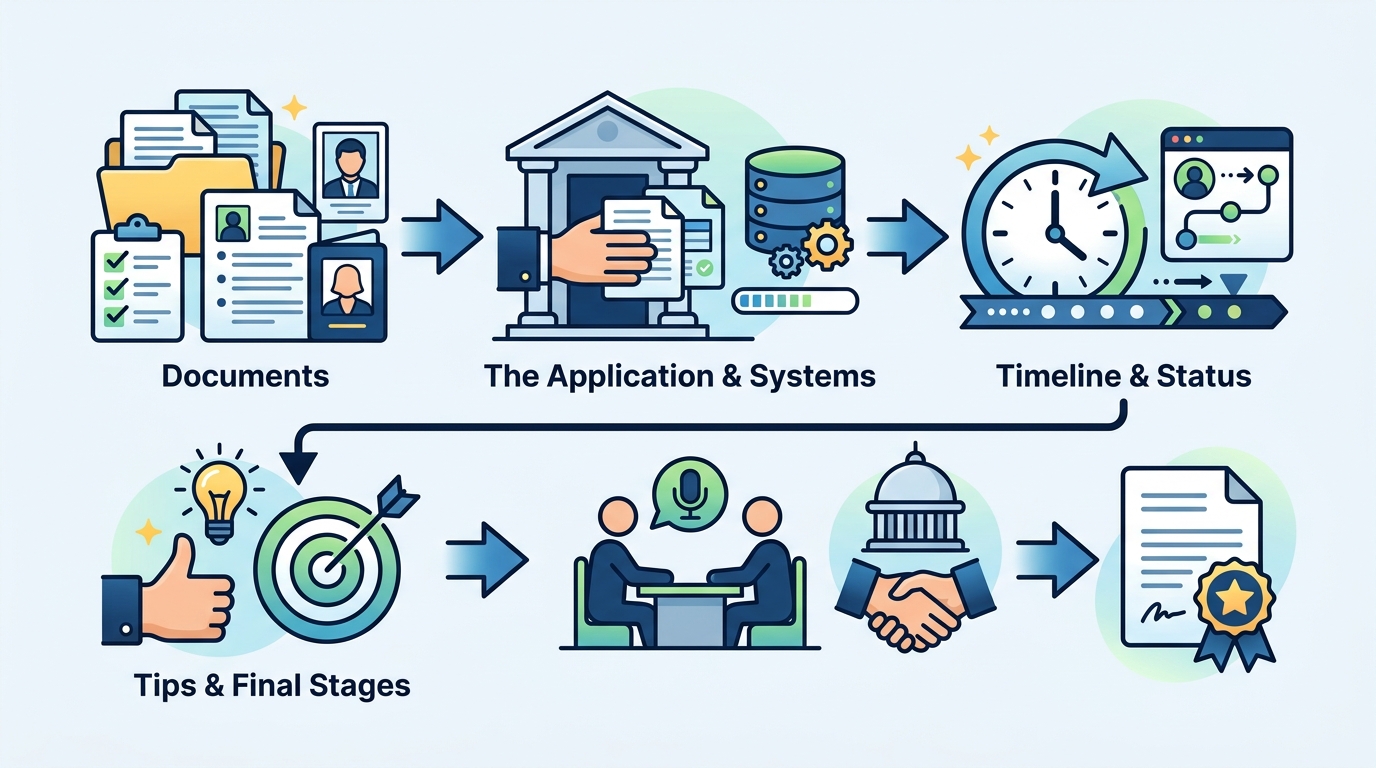
Applying for a federal job means following the vacancy announcement to the letter: a resume formatted for federal review, any eligibility documents such as transcripts or a DD-214, and an occupational questionnaire completed before you hit submit. USAJOBS walks you through attaching a resume and required documents in a five-step process after you click Apply (USAJOBS, undated), but the documents themselves have to be ready beforehand.
Expect the process to run longer than private-sector hiring and to end with a tentative offer that only becomes final after a background investigation.
What Employers Expect From Applicants
Start with the Job Opportunity Announcement itself. Before applying, read the Duties, Requirements and Qualifications sections, plus the listed locations, security clearance level and physical demands (CareerOneStop, undated). The announcement's "Required Documents" section is the authoritative list for that vacancy — it governs, not general advice.
Almost every application needs a federal-style resume. Agencies accept resumes up to two pages to comply with the Merit Hiring Plan, and USAJOBS will not allow you to upload or build a longer one (USAJOBS Help Center, undated). The USAJOBS resume builder is formatted so you include everything federal agencies require (CareerOneStop, undated), which makes it the safer choice if you are unsure what belongs in a work-history entry.
Federal resume work-history entry
Program Assistant, Rivermont County Housing Authority, Dayton, OH | June 2021 – March 2024 | 40 hours per week | Supervisor: Dana Whitfield, (937) 555-0148, may contact. Processed 60 to 80 housing voucher applications a month, cutting average intake review time from six days to four by rebuilding the document checklist used by three caseworkers.
Other documents are tied to what you claim. Positive-education positions need transcripts. Veterans' preference requires a DD-214 or other acceptable documentation (USAJOBS Help Center, undated), and a 10-point claim requires Form SF-15 or acceptable alternative proof (USAJOBS Help Center, undated). Before submitting, you may also have to answer eligibility questions or complete an occupational questionnaire (USAJOBS Help Center, undated).
Pay is set by grade and step, with a locality adjustment; check OPM's current pay tables for the grade in the announcement.
Never adjust dates, hours or credentials to fit a requirement — these documents are verified.
–
Example documents by claim
- Education requirement: unofficial transcripts at application, official on entry on duty
- 5-point veterans' preference: DD-214, certificate of release or discharge, or other acceptable documentation (USAJOBS Help Center, undated)
- 10-point veterans' preference: SF-15, the OPM standard form used by agencies and OPM examining offices to adjudicate preference claims (NIST, undated), or a VA letter showing dates of service, discharge status and disability rating (USAJOBS, undated)
Application Checklist
Build these before you open an announcement with a closing date three days away.
- A USAJOBS account with your profile completed, including citizenship, veterans' preference and federal employment history fields
- A two-page federal resume, built in the USAJOBS resume builder or uploaded as your own document (CareerOneStop, undated), showing employer, city, dates by month and year, hours per week, and salary or grade for each role
- Up to five stored resumes in your USAJOBS account, tailored to different occupational series, with the option to make one searchable so agencies can find you (USAJOBS guidance, undated)
- Scanned transcripts for every degree you plan to claim, including the degree-conferred date
- A copy of your DD-214 or other acceptable discharge documentation if you are claiming veterans' preference (USAJOBS Help Center, undated)
- A completed SF-15, or a VA letter showing dates of service, discharge status and disability rating, for a 10-point claim (USAJOBS, undated)
- Your most recent SF-50 if you are a current or former federal employee claiming status
- Copies of active licenses or certifications named in the announcement, with license numbers and expiration dates visible
- Three professional references with job titles, current phone numbers and email addresses, each asked in advance
- A record of former supervisors' contact details and whether you consent to them being contacted
- A saved copy of the full announcement, including the vacancy number and required documents list, since postings come down after closing
- Thirty to sixty uninterrupted minutes for the occupational questionnaire, which may ask you to rate and justify each competency (USAJOBS Help Center, undated)
Typical Hiring Timeline
Timelines vary by agency, hiring authority and clearance level. Government-wide, it took an average of 101.2 days to hire across the federal government in fiscal year 2023 — a day longer than FY2022 and four days longer than FY2021 (FEDmanager, undated). OPM's guidance, meanwhile, sets an overall 80-calendar-day target.
- Announcement open period — a few days to about a month. Many announcements close on a fixed date; some close early once a cap on applications is reached, so apply as soon as your documents are ready rather than on the final day.
- Eligibility and qualifications review — roughly 2 to 6 weeks after closing. The agency reviews applications and places qualified applicants into categories such as "Minimally qualified" and "Highest qualified" (USAJOBS Help Center, undated). Your USAJOBS status updates as this happens.
- Referral to the hiring official and interviews — 2 to 8 weeks. Interviews may be panel, in person, video or phone, and there may be more than one round (USAJOBS Help Center, undated).
- Selection and tentative job offer — about 3 days once a selection is made. OPM's Hiring Process Analysis Tool puts the tentative offer and acceptance element at three days, during which HR solicits and verifies documents such as the DD-214, college transcripts, the OF-306 and a Declaration for Federal Employment if not already provided (OPM, undated). Applicants not chosen see the status change to "Hiring complete" (USAJOBS Help Center, undated).
- Background investigation and security checks — weeks to many months. Once you accept the tentative offer, the agency starts the background investigation, and the offer becomes final only after that and any additional security checks are complete (USAJOBS Help Center, undated).
- Official offer and entry on duty. OPM allows two days for the selectee to accept or decline the official offer (OPM, undated). Under OPM's End-to-End Hiring Roadmap and Merit Hiring Plan, agencies aim for 66 calendar days from validated hiring need to tentative offer, 2 days for acceptance, and entry on duty within 14 days of acceptance (OPM, 2026-09-30).
Where and How to Apply
| Channel | Typical response time | Best use case |
|---|---|---|
| USAJOBS.gov announcement | Status updates after the closing date; review and referral commonly take weeks (USAJOBS Help Center, undated) | Competitive service vacancies; the default for most agencies, with the five-step apply flow for resume and required documents (USAJOBS, undated) |
| Searchable resume in your USAJOBS profile | Passive — contact comes only if a recruiter searches | Letting agencies find you between applications; you can store up to five resumes and mark one searchable (USAJOBS guidance, undated) |
| Excepted-service agency career sites | Varies entirely by agency; no USAJOBS status tracking | Agencies Congress has excepted from the competitive service, such as the U.S. Postal Service and the Central Intelligence Agency, whose announcements need not appear on USAJOBS.gov (CareerOneStop, undated) |
| Agency HR or program-office contact listed on the announcement | Days, for questions only | Clarifying required documents, grade level or duty location before the announcement closes — not a substitute for applying |
| Federal job fairs and agency recruitment events | Same-day conversation, formal application still required | Direct-hire and hard-to-fill series, where a recruiter can point you to the right announcement number |
Frequently asked questions
Does my federal resume really have to be two pages?
Yes. Federal agencies only accept resumes up to two pages to comply with the Merit Hiring Plan, and USAJOBS will not allow you to upload or build a resume longer than that (USAJOBS Help Center, undated). Cut older or unrelated roles rather than shrinking required details like employment dates, hours per week and grade, which reviewers use to credit your experience.
What happens after the announcement closes?
The hiring agency reviews applications for eligibility and qualifications, then places qualified applicants into categories including "Minimally qualified" and "Highest qualified" (USAJOBS Help Center, undated). Only referred applicants move to interviews, which may be panel, in person, video or phone, sometimes across more than one round (USAJOBS Help Center, undated). Track your status in your USAJOBS account rather than contacting the hiring official.
When does the background investigation start?
After you accept the tentative job offer. The agency then begins the background investigation, and the offer becomes final only once that investigation and any additional security checks are finished (USAJOBS Help Center, undated). Around the tentative offer stage, HR also solicits and verifies documents such as your DD-214, college transcripts, the OF-306 and a Declaration for Federal Employment if you have not already provided them (OPM, undated).
Are all federal jobs posted on USAJOBS?
No. In some cases Congress has excepted all positions in an agency from the competitive service — the U.S. Postal Service and the Central Intelligence Agency are examples — and some agencies' announcements are not required to be posted on USAJOBS.gov (CareerOneStop, undated). If you are targeting one of those agencies, check its own careers site directly and expect a different application system and document list.
How long should I expect the whole process to take?
Plan for months, not weeks. Across the federal government it took an average of 101.2 days to hire in fiscal year 2023 (FEDmanager, undated). OPM's guidance envisions 66 days from a validated hiring need to a tentative job offer, two days to accept, and entry on duty within 14 days of acceptance (OPM, 2026-09-30). Positions requiring security clearances routinely run longer.
Sources
- USAJOBS — USAJOBS - official employment site for the federal government
- NLRB (reproducing USAJOBS guidance) — How to Apply: Applying on USAJobs.gov

Written by
Priya turns job-market numbers into something readable, chasing the story behind a wage chart or an unemployment figure. She's most interested in what statistics miss about an actual day at work.